- 10 min read

Collecting survey responses is easy.
Collecting accurate, meaningful, and actionable responses is much harder.
Many organizations spend significant time designing surveys, only to discover that the final data is incomplete, inconsistent, or filled with irrelevant answers. One of the biggest reasons for poor survey data quality is that every respondent receives the same questions, regardless of their situation.
This is where survey branching logic becomes a game changer.
Also known as survey skip logic or conditional logic in surveys, branching allows surveys to adapt based on respondents’ answers. Instead of forcing everyone through the same experience, smart surveys ask only the questions that matter.
The result?
Higher completion rates, better respondent experiences, and dramatically improved data quality.
What Is Survey Branching Logic?
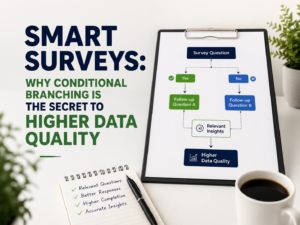
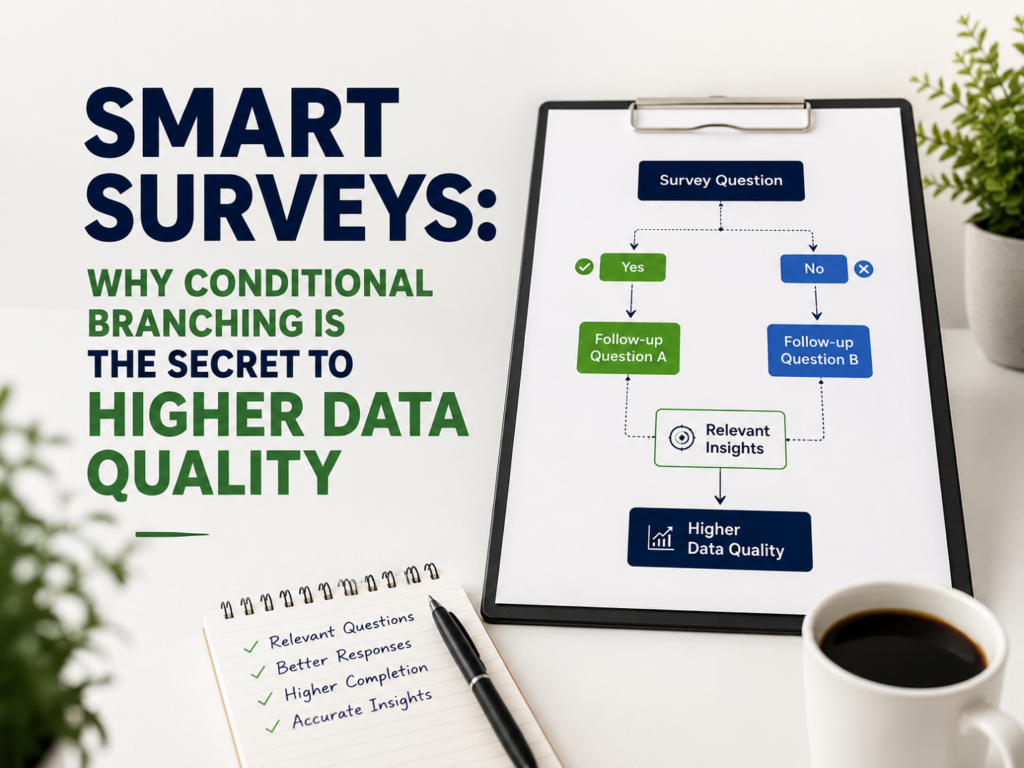
Survey branching logic is a survey feature that changes the path of questions based on previous responses.
For example:
Question: Are you currently using project management software?
- Yes → Ask which software they use and what challenges they face.
- No → Ask what is preventing adoption.
Each respondent sees a different set of questions based on their unique circumstances.
This creates a personalized survey experience that feels shorter, more relevant, and more engaging.
Why Traditional Surveys Produce Poor Data
Many surveys suffer from several common problems:
- Respondent Fatigue: People become frustrated when they must answer irrelevant questions.
- Survey Abandonment: Long surveys lead to lower completion rates.
- Inaccurate Answers: Respondents often choose random answers simply to finish quickly.
- Contradictory Data: Respondents answer questions that do not apply to them, creating inconsistent datasets.
These issues directly reduce data quality and make decision-making more difficult.
How Branching Logic Improves Data Quality
Understanding how branching logic improves data quality is essential for researchers, marketers, and product teams.
1. Respondents Only See Relevant Questions
Relevance is one of the biggest drivers of survey engagement.
When respondents feel that questions apply to them, they are more likely to provide thoughtful and accurate responses.
For example:
A customer who has never used your mobile app should not be asked detailed questions about app usability.
Removing irrelevant questions increases response accuracy significantly.
2. Lower Survey Fatigue
Long surveys create mental fatigue.
As fatigue increases:
- Response quality declines
- Completion rates drop
- Straight-line answers become more common
Conditional surveys eliminate unnecessary questions, making surveys feel shorter even when collecting more information.
3. Better Open-Ended Responses
People write better answers when questions are directly related to their experiences.
Relevant follow-up questions often generate richer qualitative insights and more actionable feedback.
4. Reduced Data Cleaning Requirements
Poor survey design often creates messy datasets filled with:
- Invalid responses
- Contradictory answers
- Missing values
Branching logic prevents many of these issues before they occur.
This means analysts spend less time cleaning data and more time generating insights.
5. Improved Survey Completion Rates
Completion rates often increase because respondents are not forced through unnecessary sections.
Higher completion rates mean larger datasets and more representative insights.
Real-World Case Study: How Smart Branching Improved Survey Results
A B2B SaaS company wanted to understand customer onboarding experiences.
Their original survey contained 35 questions and was sent to all users.
Initial Results
- Completion Rate: 41%
- Average Completion Time: 14 minutes
- Incomplete Responses: 29%
- Conflicting Answers: High
The problem became clear.
Customers who never completed onboarding were still being asked detailed questions about advanced product features.
The survey experience felt frustrating and irrelevant.
The Solution
The company redesigned the survey using conditional logic in surveys.
New survey paths included:
New Customers
Questions focused on onboarding challenges.
Active Users
Questions focused on feature usage and satisfaction.
Churned Users
Questions focused on reasons for leaving.
Power Users
Questions focused on advanced workflows and product improvements.
Results After Implementing Branching Logic
Within two months, the company saw significant improvements:
- Completion Rate Increased to 68%
- Average Completion Time Reduced by 37%
- Open-Ended Response Quality Improved Significantly
- Data Cleaning Requirements Reduced by 45%
- Customer Satisfaction with Surveys Increased
Most importantly, the business gained insights that directly improved onboarding and reduced churn.
Common Examples of Survey Branching Logic
Customer Satisfaction Surveys
Unsatisfied customers can receive follow-up questions asking for additional details.
Satisfied customers can be directed toward referral opportunities.
Product Feedback Surveys
Users who use Feature A can receive feature-specific questions.
Users who never used it can explain adoption barriers.
Employee Engagement Surveys
Managers and individual contributors may receive entirely different question paths.
Market Research Surveys
Only qualified respondents continue to detailed sections, improving sample quality.
Healthcare and Compliance Surveys
Patients with specific conditions can receive customized question sets while skipping irrelevant sections.
Survey Skip Logic vs Survey Branching Logic
Although these terms are often used interchangeably, there are slight differences.
Survey Skip Logic
Typically refers to skipping questions based on responses.
Example:
“No” → Skip Section 2.
Survey Branching Logic
More advanced and dynamic.
It can:
- Create multiple pathways
- Trigger custom question sequences
- Personalize entire survey experiences
Modern survey platforms often combine both approaches.
Best Practices for Using Conditional Logic in Surveys
Keep Logic Simple
Overly complicated survey flows can become difficult to maintain.
Start simple and expand gradually.
Test Every Path
One broken logic rule can ruin an entire survey experience.
Always test all respondent journeys before publishing.
Use Screening Questions Early
Identify respondent types immediately so branching can begin as early as possible.
Avoid Excessive Question Depth
Even personalized surveys should remain concise.
Relevance improves quality, but length still matters.
Review Analytics Frequently
Survey analytics can reveal:
- Drop-off points
- Confusing logic paths
- Unanswered questions
- Segments requiring optimization
Why SurveyFlip Is Ideal for Survey Branching Logic
Building advanced branching surveys should not require coding expertise.
SurveyFlip makes survey branching logic simple and accessible for teams of all sizes.
Easy Visual Logic Builder
Create conditional survey flows without technical complexity.
Set rules such as:
- If respondent selects Option A → Show Question Set A
- If respondent selects Option B → Skip to Section 4
Everything can be configured through an intuitive interface.
Personalized Survey Experiences
SurveyFlip allows businesses to create highly relevant experiences for different customer segments.
This improves:
- Response quality
- Completion rates
- Customer engagement
Advanced Segmentation
Create different survey paths based on:
- Customer type
- Industry
- Product usage
- Subscription plans
- Geographic location
Cleaner Data Collection
Because respondents only answer relevant questions, SurveyFlip helps reduce:
- Data inconsistencies
- Survey fatigue
- Random responses
- Incomplete submissions
Real-Time Analytics
SurveyFlip provides instant visibility into:
- Completion rates
- Response patterns
- Drop-off points
- Segment-level insights
This allows teams to continuously optimize survey performance.
Industries That Benefit Most From Survey Branching Logic
Although every organization can benefit from branching surveys, certain industries see particularly strong results.
- SaaS and Technology: Personalized onboarding and product feedback surveys.
- Healthcare: Condition-based questionnaires and patient experiences.
- Education: Student-specific feedback based on courses and learning experiences.
- Human Resources: Role-specific employee engagement surveys.
- Market Research: Better respondent qualification and segmentation.
- E-commerce: Customized feedback based on purchase behavior.
The Future of Smart Surveys
Survey expectations are changing.
People increasingly expect personalized experiences.
Generic surveys filled with irrelevant questions feel outdated and frustrating.
As AI and automation continue to evolve, smart surveys powered by conditional logic in surveys will become standard practice.
Organizations that adopt intelligent survey design today will gain:
- Better insights
- Higher response rates
- Improved customer experiences
- More confident decision-making
Final Thoughts
The quality of your decisions depends on the quality of your data.
And the quality of your data depends heavily on the quality of your survey experience.
Survey branching logic helps organizations ask better questions, collect more relevant answers, and eliminate unnecessary respondent friction.
Understanding how branching logic improves data quality is no longer optional for businesses that rely on customer, employee, or market insights.
By implementing survey skip logic and advanced conditional logic in surveys, organizations can transform ordinary surveys into intelligent data collection systems.
Platforms like SurveyFlip make it easier than ever to create personalized survey experiences that improve engagement, increase completion rates, and generate more reliable insights.
Because smarter surveys do not simply collect more data.
They collect better data.
Frequently Asked Questions (FAQs)
1. What is survey branching logic?
Survey branching logic is a feature that changes the survey path based on a respondent’s previous answers. Instead of showing every question to every participant, the survey automatically displays only the most relevant questions, creating a more personalized experience.
2. How does branching logic improve data quality?
Branching logic improves data quality by removing irrelevant questions, reducing respondent fatigue, increasing completion rates, and encouraging more accurate answers. Respondents are more likely to provide thoughtful feedback when questions directly apply to them.
3. What is the difference between survey branching logic and survey skip logic?
Survey skip logic typically skips certain questions based on specific responses. Survey branching logic is more advanced and can create multiple survey paths, personalized question sequences, and dynamic respondent experiences.
4. Why are smart surveys better than traditional surveys?
Smart surveys adapt to each respondent’s situation, making surveys feel shorter and more relevant. This leads to higher engagement, lower abandonment rates, and better-quality insights compared to traditional one-size-fits-all surveys.
5. Can survey branching logic increase survey completion rates?
Yes. By showing only relevant questions, branching logic reduces survey fatigue and keeps respondents engaged, often resulting in significantly higher completion rates.
6. What industries benefit most from conditional logic in surveys?
Many industries benefit from conditional surveys, including:
- SaaS and technology
- Healthcare
- Education
- Human resources
- Market research
- E-commerce
- Financial services
- Customer experience management
7. How does conditional logic reduce survey fatigue?
Conditional logic eliminates unnecessary questions. Respondents spend less time answering irrelevant sections, making the survey experience smoother and less frustrating.
8. Can branching logic help reduce incomplete responses?
Yes. Since respondents only answer questions relevant to their experiences, they are less likely to abandon the survey or skip questions, reducing incomplete datasets.
9. Is survey branching logic difficult to implement?
Not anymore. Modern survey platforms like SurveyFlip provide visual builders that allow users to create branching rules without coding knowledge.
10. What are some examples of survey branching logic?
Examples include:
- Asking churn questions only to former customers
- Showing product-specific questions based on feature usage
- Directing dissatisfied customers to follow-up feedback questions
- Displaying different onboarding questions for new and existing users
11. Can survey branching logic improve customer experience surveys?
Absolutely. Personalized customer experience surveys feel more relevant and respectful of respondents’ time, leading to better engagement and more reliable feedback.
12. How many branching rules should a survey have?
There is no fixed number. However, surveys should remain easy to understand and manage. Too many complex logic paths can create maintenance challenges and increase the risk of errors.
13. Does branching logic improve open-ended responses?
Yes. When follow-up questions are highly relevant, respondents are more willing to provide detailed explanations and meaningful feedback.
14. What are common mistakes when using survey branching logic?
Common mistakes include:
- Creating overly complicated logic paths
- Forgetting to test all survey flows
- Asking too many follow-up questions
- Using unclear screening questions
- Failing to monitor survey analytics after launch
15. Why is SurveyFlip a good choice for survey branching logic?
SurveyFlip provides an easy-to-use visual logic builder, advanced audience segmentation, real-time analytics, and personalized survey experiences that help businesses collect cleaner, more actionable data with minimal effort.
16. Does survey branching logic work for market research surveys?
Yes. Market researchers frequently use branching logic to qualify respondents, segment audiences, and gather deeper insights while reducing respondent burden.
17. Can branching surveys help improve decision-making?
Yes. Better survey experiences lead to cleaner and more representative data, allowing businesses to make more confident, data-driven decisions.
18. Is conditional logic important for modern surveys?
Absolutely. As users increasingly expect personalized experiences, conditional logic has become one of the most important features for creating intelligent, high-performing surveys.