- 12 min read

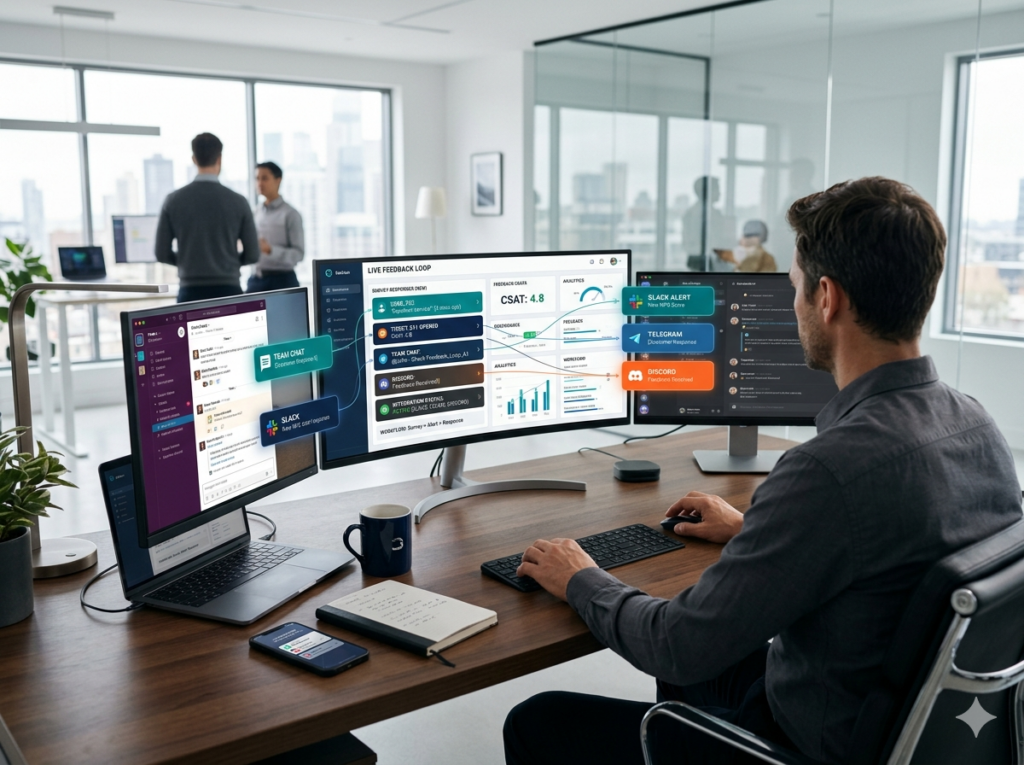
In today’s fast-moving digital economy, speed matters. Businesses can no longer afford to wait days—or even hours—to discover what customers are thinking. Customer expectations change quickly, products evolve rapidly, and competitors react faster than ever. The organizations that win in 2026 are not necessarily the ones collecting the most data; they are the ones acting on customer feedback first.
This is where real time survey notifications are changing the game.
Traditional survey workflows often create delays between collecting feedback and acting on it. A customer submits a response, the data sits in a dashboard, and someone eventually reviews it later. Valuable insights can be missed, urgent issues can remain unresolved, and opportunities to improve customer experiences may disappear before teams even notice them.
Modern businesses need a different approach.
Instead of waiting for team members to manually check survey dashboards, organizations are now connecting survey responses directly to workplace communication platforms like Slack, Telegram, and Discord. This creates an immediate feedback loop where customer insights arrive instantly in the tools teams already use every day.
Platforms such as SurveyFlip are helping businesses bridge this gap by enabling seamless integrations that transform surveys into real-time communication systems. As a result, teams can respond faster, collaborate better, and make more informed decisions based on live customer data.
This shift is redefining how organizations approach customer feedback automation, real time data collection, and the ability to send customer feedback to chat apps.
Why Real-Time Feedback Matters More Than Ever
Customer feedback has always been valuable.
What has changed is the speed at which businesses need to act on it.
A dissatisfied customer today can post a review, share their experience on social media, or switch to a competitor within minutes. Waiting until the end of the week to analyze survey responses is no longer an effective strategy.
Real-time feedback helps organizations identify issues as they happen.
Imagine a customer reports a problem with a checkout process. If that feedback reaches the product team immediately through Slack or Discord, the issue can be investigated before hundreds of additional customers experience the same problem.
Similarly, positive feedback can be acted upon quickly. Sales teams can identify promoters, marketing teams can collect testimonials, and customer success teams can strengthen relationships while engagement is high.
The value of feedback increases dramatically when it becomes actionable in real time.
The Evolution of Feedback Loops
Historically, feedback loops were slow and disconnected.
A survey response would be stored in a database or dashboard. Team members needed to remember to log in, review responses, export reports, and share findings internally.
This process created multiple bottlenecks.
Important feedback could be overlooked. Communication delays could slow decision-making. Different departments often worked from different information sources.
Modern organizations are moving toward continuous feedback systems.
Instead of waiting for scheduled reports, customer insights flow directly into communication channels where teams already collaborate.
This approach transforms surveys from passive data collection tools into active business intelligence systems.
The result is faster action, better alignment, and improved customer experiences.
What Are Real Time Survey Notifications?
Real time survey notifications are automated alerts that are triggered whenever a new survey response is submitted.
Instead of storing feedback silently inside a survey platform, the system immediately delivers the response to designated communication channels.
Notifications can include:
- Customer ratings.
- Open-ended feedback.
- Net Promoter Score (NPS) responses.
- Employee survey submissions.
- Product feedback.
- Market research responses.
- Lead generation survey entries.
- Support satisfaction ratings.
These alerts appear instantly inside workplace communication platforms, allowing teams to review and act on feedback without leaving their daily workflows.
This creates a highly responsive environment where insights reach decision-makers immediately.
How SurveyFlip Makes Feedback Instantly Actionable
SurveyFlip is designed to simplify feedback collection while helping organizations act on insights faster.
One of its most valuable capabilities is the ability to integrate survey responses directly with popular communication platforms.
Rather than requiring teams to constantly monitor dashboards, SurveyFlip can automatically send survey responses where conversations are already happening.
This approach reduces friction and ensures customer feedback becomes part of everyday decision-making.
When feedback arrives directly inside team communication channels, it becomes visible, actionable, and impossible to ignore.
Organizations can create automated workflows that notify specific departments based on survey responses, customer sentiment, or survey types.
This allows teams to respond quickly and prioritize issues more effectively.
SurveyFlip + Slack: Bringing Customer Feedback to Your Team Channels
Slack has become one of the most widely used workplace communication platforms in the United States.
Teams rely on Slack for collaboration, project management, and operational communication.
By integrating SurveyFlip with Slack, businesses can automatically deliver survey responses directly into designated Slack channels.
Imagine receiving:
- A new customer satisfaction response in your customer success channel.
- A product feature request in your product development channel.
- A low NPS score in a customer support escalation channel.
- A lead generation survey response in a sales channel.
Instead of waiting for someone to review survey results later, teams receive immediate visibility into customer feedback.
This significantly improves response times and cross-functional collaboration.
Customer issues can be addressed faster, and opportunities can be acted upon while they are still relevant.
SurveyFlip + Telegram: Instant Mobile Feedback Alerts
Many businesses rely on Telegram for fast communication, especially distributed teams and remote organizations.
SurveyFlip’s Telegram integration allows survey responses to be delivered instantly to Telegram groups, channels, or team discussions.
This capability is particularly valuable for organizations that need mobile-friendly access to customer insights.
Managers can receive notifications while traveling, remote teams can stay informed without logging into multiple systems, and urgent customer concerns can be escalated immediately.
The combination of surveys and Telegram creates a highly responsive feedback environment where data follows teams wherever they work.
SurveyFlip + Discord: Real-Time Community Feedback Management
Discord has evolved far beyond gaming communities.
Today, many SaaS companies, startups, online communities, educational platforms, and creator businesses use Discord as a central communication hub.
SurveyFlip’s Discord integration allows organizations to push survey responses directly into specific Discord channels.
This is especially useful for:
- Product beta testing.
- Community feedback programs.
- Customer engagement initiatives.
- Feature request management.
- User research projects.
Feedback becomes instantly visible to community managers, developers, and leadership teams.
Instead of waiting for reports, teams can monitor customer sentiment and react in real time.
This creates stronger relationships with users while accelerating product improvements.
Customer Feedback Automation Improves Team Efficiency
One of the biggest advantages of integrating surveys with chat applications is customer feedback automation.
Manual processes consume valuable time.
Without automation, someone must regularly check dashboards, export data, share reports, and communicate findings across teams.
Automation eliminates these repetitive tasks.
Survey responses are automatically delivered to the right people at the right time.
This reduces administrative workload while ensuring no critical feedback gets overlooked.
Teams spend less time searching for information and more time solving problems.
The result is increased productivity and better customer outcomes.
Real Time Data Collection Creates Faster Decision-Making
The value of real time data collection extends beyond customer support.
Every department benefits from immediate access to feedback.
Marketing teams can identify campaign reactions.
Product teams can discover usability issues.
HR departments can monitor employee sentiment.
Sales teams can identify high-intent prospects.
Executives can monitor customer satisfaction trends.
When data arrives instantly, decisions can be made with greater confidence and speed.
Organizations become more agile because they are operating with current information rather than historical reports.
Send Customer Feedback to Chat Apps for Better Collaboration
One of the biggest challenges in customer experience management is ensuring feedback reaches the right people.
Survey dashboards often become information silos.
A customer complaint may never reach the product team.
A feature request may never reach engineering.
A positive review may never reach marketing.
When businesses send customer feedback to chat apps, insights become visible across the organization.
Teams can collaborate immediately.
Product managers can ask follow-up questions.
Support teams can investigate issues.
Leadership can monitor trends.
Marketing teams can identify customer success stories.
The entire organization becomes more connected to customer needs.
Real-Time Alerts Help Prevent Customer Churn
Customer churn often occurs when organizations fail to recognize dissatisfaction early.
By the time monthly reports reveal a problem, customers may already be gone.
Real-time notifications help businesses identify at-risk customers immediately.
For example, a low satisfaction score can automatically trigger a Slack alert.
A support manager can review the feedback, contact the customer, and resolve the issue before the relationship deteriorates.
This proactive approach can significantly improve retention and customer loyalty.
Speed often makes the difference between saving a customer and losing one.
Building a Data-Driven Culture
Organizations that leverage real-time survey notifications often develop stronger data-driven cultures.
Feedback becomes part of everyday conversations.
Employees become more aware of customer needs.
Teams make decisions based on evidence rather than assumptions.
This continuous visibility creates a culture where customer insights guide actions across departments.
Instead of treating surveys as occasional research projects, businesses transform them into ongoing sources of strategic intelligence.
The Future of Real-Time Feedback Systems
As artificial intelligence and automation continue to evolve, feedback systems will become even more sophisticated.
Future survey platforms will likely include:
- AI-powered response categorization.
- Automatic sentiment analysis.
- Predictive customer risk alerts.
- Smart routing of feedback.
- Automated workflow triggers.
- Real-time business intelligence dashboards.
The integration between survey platforms and communication tools will continue to strengthen, making customer feedback more actionable than ever before.
Organizations that adopt these capabilities early will gain significant competitive advantages.
Final Thoughts
The future of customer feedback is not just about collecting more responses—it is about acting on insights faster.
Real time survey notifications enable businesses to transform surveys into live communication systems that drive immediate action. By leveraging customer feedback automation, embracing real time data collection, and choosing solutions that can send customer feedback to chat apps, organizations can dramatically improve responsiveness, collaboration, and decision-making.
With integrations for Slack, Telegram, and Discord, SurveyFlip helps businesses close the gap between collecting feedback and acting on it.
In a world where customer expectations continue to rise, the organizations that respond first are often the organizations that win.
Frequently Asked Questions (FAQ)
1. What are real time survey notifications?
Real time survey notifications are instant alerts sent whenever a survey response is submitted. Instead of waiting to review survey dashboards, teams receive immediate notifications in platforms like Slack, Telegram, or Discord, allowing them to act on feedback right away.
2. Why are real-time survey notifications important?
Real-time notifications help businesses respond faster to customer feedback, identify issues before they escalate, improve customer satisfaction, and make data-driven decisions without delays. Speed is often the difference between retaining and losing a customer.
3. How does customer feedback automation work?
Customer feedback automation automatically routes survey responses to designated channels, teams, or workflows. Instead of manually checking survey results, feedback is delivered instantly to the right people, reducing administrative work and improving response times.
4. What is real time data collection?
Real time data collection refers to gathering and processing survey responses immediately after submission. This allows organizations to monitor customer sentiment, employee feedback, and market insights as they happen rather than waiting for scheduled reports.
5. Can SurveyFlip send customer feedback to chat apps?
Yes. SurveyFlip can send customer feedback to chat apps through integrations with platforms such as Slack, Telegram, and Discord. This ensures feedback reaches teams instantly and becomes part of their daily workflow.
6. How does SurveyFlip integrate with Slack?
SurveyFlip can automatically send survey responses to specific Slack channels. Teams can receive customer feedback, NPS responses, support ratings, feature requests, and survey submissions directly within Slack, allowing for faster collaboration and action.
7. How does SurveyFlip work with Telegram?
SurveyFlip’s Telegram integration delivers survey responses directly to Telegram groups, channels, or chats. This helps remote teams and mobile-first organizations stay informed about customer feedback in real time.
8. Can SurveyFlip send survey responses to Discord?
Yes. SurveyFlip integrates with Discord, allowing survey responses to be posted automatically in selected Discord channels. This is particularly useful for SaaS companies, online communities, beta testing programs, and customer engagement initiatives.
9. What types of surveys can trigger real-time notifications?
Almost any survey can trigger notifications, including:
- Customer satisfaction surveys
- NPS surveys
- Employee feedback surveys
- Product feedback surveys
- Event surveys
- Market research surveys
- Lead generation forms
- Customer support surveys
10. How do real-time notifications improve customer experience?
When feedback reaches teams immediately, businesses can resolve issues faster, respond to concerns promptly, and act on opportunities while they are still relevant. This leads to better customer experiences and higher satisfaction levels.
11. Can real-time survey notifications help reduce customer churn?
Absolutely. Instant alerts allow organizations to identify dissatisfied customers quickly. Teams can follow up, address concerns, and resolve problems before customers decide to leave, helping improve retention rates.
12. Are Slack, Telegram, and Discord integrations useful for small businesses?
Yes. Small businesses often have limited resources and benefit greatly from automation. Real-time survey integrations help small teams stay connected to customer feedback without spending time manually reviewing survey dashboards.
13. What are the benefits of sending customer feedback to chat apps?
Benefits include:
- Faster response times
- Better team collaboration
- Increased visibility of customer insights
- Reduced manual work
- Improved customer retention
- Quicker decision-making
- Enhanced accountability across teams
14. Can different teams receive different survey responses?
Yes. SurveyFlip integrations can be configured so that specific survey responses are routed to different channels. For example, customer complaints can go to support teams while feature requests go directly to product teams.
15. Is real-time data collection better than traditional reporting?
For many organizations, yes. Traditional reporting often introduces delays, while real time data collection enables immediate awareness and action. Businesses can identify trends, solve problems, and capitalize on opportunities much faster.
16. Why should businesses use SurveyFlip for customer feedback automation?
SurveyFlip helps organizations close the gap between collecting feedback and taking action. With powerful survey tools and integrations for Slack, Telegram, and Discord, businesses can automate feedback workflows, improve collaboration, and turn customer insights into real business results.