- 13 min read

In today’s digital-first business environment, data is one of the most valuable assets an organization can collect. Whether you’re generating leads, gathering customer feedback, conducting market research, onboarding employees, or processing registrations, the information you collect helps shape better decisions and drive business growth.
However, many businesses struggle with choosing the right data collection methods. One of the most common questions is whether to use an online form or a survey. While these tools may appear similar at first glance, they serve different purposes and can produce very different outcomes depending on how they are used.
Choosing the wrong tool can result in lower response rates, poor-quality data, and missed business opportunities. Choosing the right one can improve customer experiences, streamline operations, and provide valuable insights that support smarter decision-making.
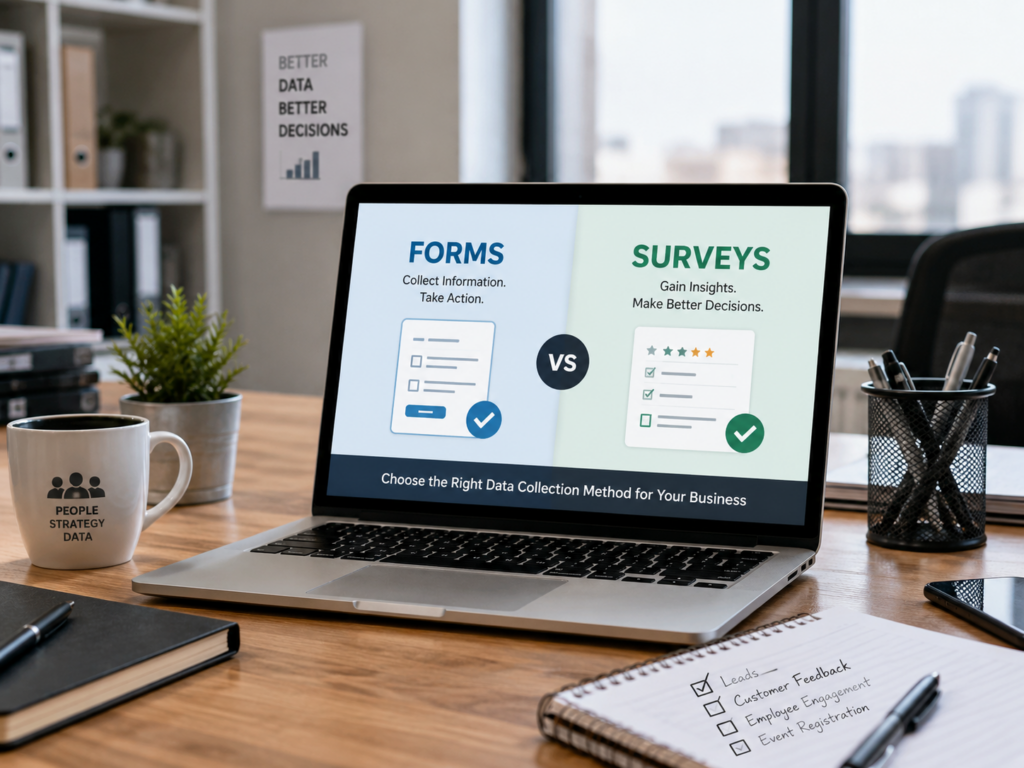
This guide explains the difference between online form and survey, explores common use cases for each, and helps you determine when to use an online form builder and when a free online survey maker is the better option.
Why Data Collection Matters More Than Ever
Modern businesses operate in a highly competitive environment where customer expectations change rapidly. Organizations that make decisions based on assumptions often struggle to keep up with market trends and customer needs.
Effective data collection helps businesses understand what customers want, identify operational issues, measure satisfaction levels, validate new ideas, and improve products or services.
The challenge is not collecting data itself. The challenge is collecting the right data using the right method.
A customer registration form and a customer satisfaction survey may both gather information, but they are designed for entirely different purposes. Understanding these differences is essential for maximizing the value of your data collection efforts.
Understanding Data Collection Methods
Before comparing forms and surveys, it helps to understand what data collection methods actually are.
Data collection methods are the tools and processes businesses use to gather information from customers, employees, prospects, partners, or other stakeholders.
These methods can include:
- Online forms
- Surveys
- Interviews
- Focus groups
- Customer feedback systems
- Polls
- Registration systems
- Research studies
Among these options, online forms and surveys are two of the most widely used digital solutions because they are scalable, cost-effective, and easy to implement.
Although both collect information, their objectives are significantly different.
What Is an Online Form?
An online form is a digital tool designed to collect specific information from users.
Forms are typically transactional in nature. They help businesses gather information required to complete a particular action or process.
For example, businesses commonly use forms for:
- Contact requests
- Lead generation
- Event registrations
- Job applications
- Newsletter subscriptions
- Customer onboarding
- Support requests
- Account creation
In most cases, the user provides information because they want something in return, such as a response, service, account access, or registration confirmation.
The information requested is usually factual and structured.
For example:
- Name
- Email address
- Phone number
- Company name
- Job title
- Shipping address
Forms are designed to collect data efficiently and accurately.
What Is a Survey?
A survey is a research and feedback tool used to collect opinions, attitudes, experiences, preferences, and perceptions.
Unlike forms, surveys are not typically focused on completing a transaction. Instead, they help organizations understand what people think.
Businesses use surveys to gather insights such as:
- Customer satisfaction
- Product feedback
- Employee engagement
- Market research
- Brand awareness
- Event feedback
- Customer experience metrics
- Net Promoter Score (NPS)
Survey questions often encourage respondents to share opinions rather than simply provide factual information.
For example:
- How satisfied are you with our service?
- How likely are you to recommend our company?
- What features would you like to see next?
- What challenges are you currently facing?
Surveys help organizations identify trends, discover opportunities, and make informed business decisions.
Difference Between Online Form and Survey
Understanding the difference between online form and survey is critical for choosing the right tool.
An online form focuses on collecting information needed to perform an action.
A survey focuses on collecting opinions and insights.
Forms typically gather operational data, while surveys gather analytical data.
For example, if a customer wants to schedule a consultation, a form is the appropriate tool because you need contact details and appointment information.
However, if you want to understand why customers choose your company over competitors, a survey is more appropriate because you need opinions and feedback.
Forms answer:
- “Who is the user?”
Surveys answer:
- “What does the user think?”
This distinction helps businesses determine which tool will generate the most valuable information for a specific goal.
When Should Businesses Use Online Forms?
Online forms are best used when organizations need to collect actionable information that supports a workflow or transaction.
Examples include:
- Lead Generation
Businesses use forms to collect contact information from potential customers interested in products or services.
- Event Registration
Forms help collect attendee information, dietary requirements, ticket selections, and contact details.
- Job Applications
Organizations use forms to gather candidate information, resumes, and qualifications.
- Customer Support
Support request forms help route inquiries to the appropriate department.
- User Account Creation
Forms collect the information necessary to establish user profiles and accounts.
In these situations, collecting accurate information quickly is the primary objective.
When Should Businesses Use Surveys?
Surveys are ideal when organizations need to understand attitudes, preferences, and experiences.
Examples include:
- Customer Satisfaction Research
Surveys help identify strengths and weaknesses in customer experiences.
- Product Development
Businesses use surveys to gather feedback on new features, functionality, and usability.
- Market Research
Organizations conduct surveys to understand consumer behavior, buying habits, and industry trends.
- Employee Engagement
Companies use surveys to measure workplace satisfaction and identify improvement opportunities.
- Brand Research
Surveys help businesses understand brand awareness, perception, and loyalty.
In these situations, gathering insights is more important than collecting contact information.
How Online Forms Help Business Operations
An online form builder is designed to streamline business processes.
Modern online form builders allow organizations to automate data collection, reduce paperwork, improve accuracy, and accelerate workflows.
For example, instead of manually collecting customer information through emails, businesses can create forms that automatically capture and organize data.
This improves efficiency while reducing administrative workloads.
Many organizations use online forms as a critical part of their sales, marketing, HR, and customer service operations.
How Surveys Support Better Business Decisions
A free online survey maker provides organizations with a simple way to gather valuable feedback at scale.
Surveys help businesses move beyond assumptions and make decisions based on actual customer opinions and experiences.
For example, a company considering a new product feature can survey customers before investing development resources.
Similarly, a customer satisfaction survey can reveal service issues before they become larger problems.
The ability to collect feedback quickly and efficiently makes surveys one of the most powerful business intelligence tools available today.
Can Forms and Surveys Work Together?
Absolutely.
Many successful organizations use forms and surveys together as part of a broader customer experience strategy.
For example:
- A lead generation form captures prospect information.
- A follow-up survey gathers feedback about the sales process.
- A registration form collects attendee details.
- An event survey measures attendee satisfaction afterward.
- A support request form captures customer issues.
- A post-resolution survey evaluates support quality.
Combining forms and surveys provides both operational and strategic insights.
Choosing the Right Tool for Your Business Goals
The best choice depends on what you need to learn.
If you need personal details, registrations, requests, or submissions, use a form.
If you need opinions, experiences, satisfaction levels, or research insights, use a survey.
Ask yourself one simple question:
“Am I collecting information to complete an action or to understand an opinion?”
If the answer is action, choose a form.
If the answer is opinion, choose a survey.
This simple framework can help prevent unnecessary complexity and improve data quality.
Why Businesses Use SurveyFlip for Forms and Surveys
Modern businesses need flexible tools that support multiple data collection methods.
SurveyFlip helps organizations create both forms and surveys through an intuitive platform designed for simplicity and scalability.
Whether you need lead capture forms, customer feedback surveys, employee engagement questionnaires, event registrations, or market research studies, SurveyFlip provides the tools needed to collect, analyze, and act on valuable information.
With customizable templates, real-time reporting, automation capabilities, and user-friendly design, businesses can build effective data collection experiences without technical expertise.
The Future of Data Collection
As artificial intelligence, automation, and customer expectations continue to evolve, data collection will become increasingly sophisticated.
Organizations will rely more heavily on real-time feedback, predictive analytics, automated workflows, and personalized experiences.
However, the fundamental distinction between forms and surveys will remain important.
Forms will continue to power transactions and operational processes.
Surveys will continue to power insights and strategic decision-making.
Businesses that understand how to use both effectively will be better positioned to compete in an increasingly data-driven world.
Final Thoughts
Choosing between forms and surveys is not about deciding which tool is better. It is about selecting the right solution for the right objective.
Understanding modern data collection methods, recognizing the difference between online form and survey, leveraging an effective online form builder, and utilizing a reliable free online survey maker can significantly improve how organizations gather and use information.
When used correctly, forms help businesses operate efficiently, while surveys help businesses learn, adapt, and grow.
The most successful organizations recognize the value of both and use them strategically to create better experiences, stronger relationships, and smarter business decisions.
Frequently Asked Questions (FAQ)
1. What are data collection methods?
Data collection methods are techniques and tools used to gather information from customers, employees, prospects, or other audiences. Common methods include online forms, surveys, interviews, focus groups, polls, feedback forms, and market research studies. Businesses use these methods to make informed decisions and improve operations.
2. What is the difference between an online form and a survey?
The primary difference between online form and survey is their purpose. An online form collects information needed to complete an action, such as a registration or contact request. A survey collects opinions, feedback, experiences, and preferences to help businesses gain insights and make better decisions.
3. When should I use an online form?
You should use an online form when you need specific information to complete a process or transaction. Common use cases include lead generation, event registration, customer onboarding, account creation, job applications, and support requests.
4. When should I use a survey?
Surveys are best used when you want to understand what people think. Businesses commonly use surveys for customer satisfaction research, employee engagement, product feedback, market research, brand perception studies, and customer experience measurement.
5. Can forms and surveys be used together?
Yes. Many businesses combine forms and surveys as part of their customer journey. For example, a lead capture form can collect prospect information, while a follow-up survey can gather feedback about the customer experience.
6. What is an online form builder?
An online form builder is a tool that allows users to create digital forms without coding. Most form builders offer drag-and-drop functionality, customizable templates, automation features, conditional logic, integrations, and mobile-friendly designs.
7. What are the benefits of using an online form builder?
An online form builder helps businesses:
- Collect information faster
- Reduce manual data entry
- Improve accuracy
- Automate workflows
- Increase lead generation
- Streamline customer interactions
- Integrate with CRM and marketing tools
These benefits help improve efficiency and productivity.
8. What is a free online survey maker?
A free online survey maker is a platform that allows businesses and individuals to create surveys without paying upfront. These tools typically offer survey templates, customizable questions, response collection, and reporting features.
9. How do surveys help businesses make better decisions?
Surveys provide direct feedback from customers, employees, and stakeholders. Instead of relying on assumptions, businesses can use survey data to identify trends, understand needs, improve products, and enhance customer experiences.
10. Are surveys better than forms?
Neither tool is inherently better. Forms and surveys serve different purposes. Forms are best for collecting actionable information, while surveys are designed for gathering opinions and insights. The right choice depends on your business objective.
11. What type of questions are used in online forms?
Online forms typically contain factual questions such as:
- Name
- Email address
- Phone number
- Company name
- Address
- File uploads
- Appointment preferences
The goal is to collect information required to complete a specific action.
12. What type of questions are used in surveys?
Surveys often include:
- Rating scale questions
- Multiple-choice questions
- Likert scale questions
- Net Promoter Score (NPS) questions
- Open-ended feedback questions
These questions help organizations understand opinions, experiences, and behaviors.
13. Can online forms improve lead generation?
Yes. Online forms are one of the most effective lead generation tools. Businesses use forms on landing pages, websites, and marketing campaigns to collect contact information from potential customers and move them into the sales process.
14. How do surveys improve customer satisfaction?
Customer surveys help organizations understand what customers like, dislike, and expect. By acting on survey feedback, businesses can improve products, services, and customer experiences, leading to higher satisfaction and loyalty.
15. What features should I look for in a survey platform?
A good survey platform should offer:
- Customizable templates
- Mobile responsiveness
- Real-time reporting
- Conditional logic
- Automated notifications
- Integrations with other tools
- Data export options
- Strong security and privacy controls
These features help maximize survey effectiveness.
16. What features should I look for in an online form builder?
When choosing an online form builder, look for:
- Drag-and-drop form creation
- Custom branding
- File upload support
- Workflow automation
- CRM integration
- Payment collection capabilities
- Mobile-friendly design
- Analytics and reporting
These capabilities help streamline business operations.
17. How can businesses choose the right data collection method?
The simplest approach is to define your goal first. If you need information to complete a transaction or process, use a form. If you need opinions, feedback, or research insights, use a survey. Matching the tool to the objective ensures better data quality and more useful results.
18. Why do modern businesses use both forms and surveys?
Successful organizations understand that forms and surveys solve different problems. Forms support operational efficiency, while surveys support strategic decision-making. Together, they provide a complete view of customers, employees, and business performance.