- 14 min read



Online surveys continue to evolve, but one challenge remains the same:
How do you collect more information without overwhelming respondents?
Businesses want detailed feedback. Respondents want shorter surveys.
This is where the matrix question survey becomes incredibly valuable.
Matrix questions allow researchers to ask multiple related questions using one consistent response scale. They help reduce survey length, improve organization, and simplify data analysis.
However, matrix questions are also one of the most misused elements in survey questionnaire design.
Poorly designed matrix questions can significantly increase survey abandonment rates, especially among mobile users.
In this guide, you’ll learn:
- What matrix survey questions are
- Why businesses use them
- Matrix survey questions examples
- Mobile optimization techniques
- Best practices for effective implementation
- Common mistakes to avoid
- How SurveyFlip simplifies matrix survey creation
What Is a Matrix Question Survey?
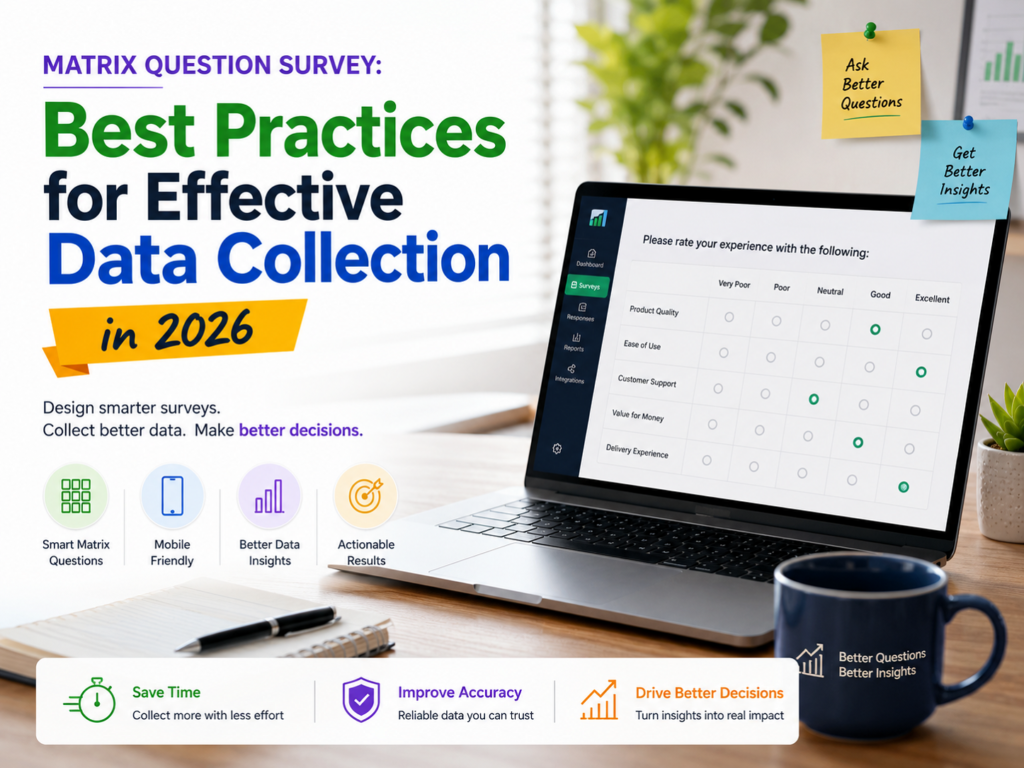
A matrix question survey is a question format that groups several similar questions together under one response scale.
Instead of asking multiple independent questions, respondents answer them in a table format.
Example:
How satisfied are you with the following aspects of our service?
| Service Area | Very Dissatisfied | Dissatisfied | Neutral | Satisfied | Very Satisfied |
| Product Quality | ○ | ○ | ○ | ○ | ○ |
| Pricing | ○ | ○ | ○ | ○ | ○ |
| Customer Support | ○ | ○ | ○ | ○ | ○ |
| Website Experience | ○ | ○ | ○ | ○ | ○ |
This structure is also known as:
- Grid questions
- Survey matrices
- Rating grids
- Grid question type in online surveys
Why Matrix Questions Matter in Modern Surveys
Today’s organizations collect more feedback than ever.
Customers receive surveys after:
- Purchases
- Support interactions
- Product usage
- Events
- App experiences
Employees receive surveys for:
- Engagement
- Satisfaction
- Company culture
- Benefits
As surveys become longer, response fatigue increases.
Matrix questions solve this problem by making surveys more efficient.
Why Businesses Use Matrix Questions
1. They Reduce Survey Length
One matrix question can replace several separate questions.
For example:
Instead of asking:
- How satisfied are you with product quality?
- How satisfied are you with pricing?
- How satisfied are you with support?
- How satisfied are you with delivery?
A single matrix can collect all responses.
Shorter surveys generally increase completion rates.
2. They Create Better Organization
Respondents can compare related items side by side.
This improves understanding and creates a smoother survey experience.
Rather than constantly scrolling through repetitive questions, respondents see all related information in one place.
3. They Improve Survey Efficiency
Researchers collect more information while asking fewer questions.
This saves time for both:
- Survey creators
- Survey respondents
4. They Simplify Reporting
Because all responses use identical scales, reporting becomes easier.
Comparisons become more meaningful.
Matrix Survey Questions Examples
Understanding practical applications helps determine whether matrix questions fit your use case.
Example 1: Customer Satisfaction Survey
Question:
How satisfied are you with the following areas?
| Area | Very Poor | Poor | Average | Good | Excellent |
| Product Quality | ○ | ○ | ○ | ○ | ○ |
| Delivery | ○ | ○ | ○ | ○ | ○ |
| Support Team | ○ | ○ | ○ | ○ | ○ |
| Pricing | ○ | ○ | ○ | ○ | ○ |
This format quickly identifies weaknesses.
Example 2: Employee Engagement Survey
Question:
Please indicate your level of agreement.
| Statement | Strongly Disagree | Disagree | Neutral | Agree | Strongly Agree |
| Leadership communicates effectively | ○ | ○ | ○ | ○ | ○ |
| I feel valued at work | ○ | ○ | ○ | ○ | ○ |
| Career growth opportunities exist | ○ | ○ | ○ | ○ | ○ |
This structure helps HR teams benchmark engagement.
Example 3: Product Feature Evaluation
Question:
How would you rate the following features?
| Feature | Very Poor | Poor | Average | Good | Excellent |
| Dashboard | ○ | ○ | ○ | ○ | ○ |
| Reporting Tools | ○ | ○ | ○ | ○ | ○ |
| Mobile Experience | ○ | ○ | ○ | ○ | ○ |
Product teams use this to prioritize improvements.
Benefits of Matrix Question Surveys
Faster Completion Times
Respondents answer multiple questions quickly.
Less scrolling means better experiences.
Reduced Repetition
People dislike answering repetitive questions.
Matrices remove unnecessary duplication.
Better Data Consistency
Because all questions share identical scales, responses become easier to compare.
Cleaner Reports
Matrix responses produce highly structured datasets.
Visualization becomes much easier.
Better Benchmarking
Organizations can compare results over time.
This is especially useful for:
- Employee surveys
- Customer satisfaction tracking
- Product improvement initiatives
The Biggest Problem With Matrix Questions
Despite their advantages, matrix questions have a major weakness:
They can become overwhelming.
Large matrices often lead to:
- Survey fatigue
- Lower completion rates
- Straight-lining
- Poor mobile experiences
This is why proper implementation is critical.
What Is Straight-Lining?
Straight-lining happens when respondents choose the same answer across every row.
Example:
| Question | Rating |
| Product Quality | 4 |
| Pricing | 4 |
| Customer Support | 4 |
| Delivery | 4 |
This often means respondents stopped paying attention.
Straight-lining reduces data quality significantly.
Best Practices for Matrix Question Surveys
1. Keep Matrices Small
Large grids intimidate respondents.
A matrix with 20 rows may save space, but it damages engagement.
Recommended:
- 5–7 rows maximum
- 5 response columns maximum
Smaller matrices perform better.
2. Group Similar Topics Together
All rows should address one specific theme.
Good example:
Customer service:
- Friendliness
- Response speed
- Knowledge
- Professionalism
Bad example:
- Product quality
- Company culture
- Pricing
- Mobile app experience
Unrelated topics create confusion.
3. Use Clear Labels
Every row should be instantly understandable.
Avoid vague wording like:
❌ “Overall experience”
Instead:
✅ “Ease of finding information”
Specific questions improve response quality.
4. Use Consistent Scales
Changing scales inside one matrix confuses respondents.
Avoid:
- Satisfaction scale
- Agreement scale
- Frequency scale
Within the same matrix.
Consistency improves accuracy.
5. Consider Mobile Users First
This is one of the biggest changes in survey design.
Most survey responses now occur on mobile devices.
Traditional matrix questions often perform poorly on smartphones.
Why Mobile Friendly Matrix Surveys Matter
A mobile friendly matrix survey is essential in 2026.
Large tables frequently cause:
- Horizontal scrolling
- Tiny text
- Selection errors
- Abandonment
Poor mobile experiences directly reduce completion rates.
Best Practices for Mobile Matrix Surveys
Reduce Rows
Shorter matrices work better on small screens.
Reduce Columns
Five-point scales often outperform ten-point scales.
Use Responsive Platforms
Modern survey platforms automatically adapt matrices.
Consider Alternative Formats
Sometimes separate questions perform better than one large matrix.
Matrix Questions and Survey Questionnaire Design
Good survey questionnaire design focuses on minimizing cognitive effort.
Ask yourself:
Can respondents answer this easily?
Will this look good on mobile?
Is grouping these questions truly helpful?
If the answer is no, avoid matrices.
When Should You Use Matrix Questions?
Use matrix questions when:
- ✅ Questions share identical answer scales
- ✅ Topics are closely related
- ✅ Survey length is becoming too long
- ✅ You want easier comparison
When Should You Avoid Matrix Questions?
Avoid matrices when:
- ❌ Mobile users dominate your audience
- ❌ Questions are unrelated
- ❌ Open-ended responses are needed
- ❌ You require detailed explanations
- ❌ The matrix would become very large
Common Matrix Survey Mistakes
Making Matrices Too Large
Huge matrices increase fatigue dramatically.
Ignoring Mobile Optimization
Many survey creators only preview surveys on desktop.
This creates terrible mobile experiences.
Poor Question Wording
Ambiguous questions create unreliable data.
Mixing Multiple Topics
Keep themes consistent.
Overusing Matrix Questions
Not every survey requires them.
Use them strategically.
Grid Question Type in Online Surveys
The grid question type in online surveys remains popular because it balances:
- Efficiency
- Structure
- Data consistency
However, its effectiveness depends entirely on execution.
The best surveys prioritize user experience over convenience.
Matrix Questions Across Different Industries
Customer Experience Surveys
Measure:
- Service quality
- Product satisfaction
- Support experiences
Employee Surveys
Evaluate:
- Leadership
- Culture
- Compensation
- Growth opportunities
Healthcare Surveys
Measure:
- Patient satisfaction
- Communication
- Appointment experiences
Education Surveys
Evaluate:
- Course effectiveness
- Instructor performance
- Student satisfaction
Market Research Surveys
Compare:
- Brand perceptions
- Product preferences
- Purchase drivers
How SurveyFlip Helps Build Better Matrix Surveys
SurveyFlip offers advanced matrix question functionality designed for modern respondents.
Features include:
- ✅ Smart Matrix Questions
- ✅ Mobile-responsive layouts
- ✅ Real-time analytics
- ✅ Easy customization
- ✅ Visual reporting dashboards
- ✅ AI-powered insights
This allows businesses to collect detailed feedback without harming survey completion rates.
The Future of Matrix Survey Questions
Matrix questions are becoming:
- More mobile-friendly
- More interactive
- Better optimized for accessibility
- Enhanced with AI-powered analytics
Survey design in 2026 focuses on one key goal:
Collect more information with less friction.
Matrix questions remain one of the most powerful tools for achieving that balance.
Pros and Cons of Matrix Questions in Surveys
Pros of Matrix Questions
1. Shortens Survey Length
Matrix questions allow you to ask multiple related questions in a single section instead of creating separate questions for each topic.
Example: Instead of asking five individual satisfaction questions, one matrix can collect all responses.
Benefit: Shorter surveys usually lead to higher completion rates.
2. Improves Survey Organization
Grouping similar questions together creates a cleaner and more professional survey experience.
Respondents can quickly understand what information is being requested.
Benefit: Better user experience and easier navigation.
3. Makes Comparisons Easier
Because all items use the same response scale, researchers can easily compare results across multiple categories.
Example:
- Product Quality: 4.5/5
- Customer Support: 3.8/5
- Pricing: 4.2/5
Benefit: Faster insight generation.
4. Creates Cleaner Data Sets
Matrix questions produce highly structured data that is easier to analyze, visualize, and report.
Benefit: Better dashboards and reporting capabilities.
5. Reduces Repetition
Respondents do not have to repeatedly read identical answer options.
Benefit: Less frustration and faster survey completion.
6. Excellent for Benchmarking
Matrix questions are ideal for:
- Employee engagement surveys
- Customer satisfaction tracking
- Product experience monitoring
Since the same scale is used repeatedly, organizations can compare results over time.
7. Works Well for Rating Multiple Attributes
Matrix surveys are perfect when evaluating:
- Products
- Services
- Features
- Experiences
- Brand perceptions
Cons of Matrix Questions
1. Poor Mobile Experience
This is the biggest drawback in 2026.
Large matrices often break on mobile devices.
Problems include:
- Horizontal scrolling
- Tiny text
- Difficult selections
- Higher abandonment rates
Impact: Lower completion rates.
2. Encourages Straight-Lining
Respondents may simply select the same answer across every row.
Example:
⭐⭐⭐⭐ for everything.
This behavior often indicates:
- Low engagement
- Survey fatigue
- Rushed responses
Impact: Poor data quality.
3. Can Become Overwhelming
Large matrices with many rows and columns intimidate respondents.
A matrix containing:
- 20 rows
- 10 columns
can feel like work rather than feedback.
Impact: Increased survey drop-off.
4. Higher Cognitive Load
Respondents must read:
- Each row
- Each column
- Multiple comparisons simultaneously
This requires more mental effort than simple questions.
Impact: Reduced response accuracy.
5. Difficult for Accessibility
Large grid questions can be challenging for:
- Older users
- Screen reader users
- Respondents with visual impairments
Accessibility issues may reduce participation.
6. May Produce Lower Data Accuracy
Because respondents answer quickly, some rows may receive less attention.
This can create:
- Random answers
- Pattern responses
- Less thoughtful feedback
7. Not Suitable for Complex Questions
Matrix questions work best for similar rating items.
They perform poorly for:
- Open-ended questions
- Detailed explanations
- Unrelated topics
- Conditional logic questions
Matrix Questions: Pros and Cons Table
| Pros | Cons |
| Shorter surveys | Poor mobile experience |
| Cleaner design | Straight-lining risk |
| Easier comparisons | Can overwhelm respondents |
| Better reporting | Higher cognitive load |
| Less repetitive | Accessibility concerns |
| Structured data | Lower response quality in large grids |
| Great for benchmarking | Not suitable for complex questions |
Final Thoughts
A well-designed matrix question survey can significantly improve data collection.
But matrices should never exist simply to save space.
The best matrix questions are:
- Short
- Clear
- Mobile-friendly
- Focused on one topic
When used correctly, matrix questions improve both respondent experience and data quality.
The goal of great survey questionnaire design isn’t collecting more answers.
It’s collecting better answers.
And in 2026, thoughtful matrix design remains one of the smartest ways to do exactly that.
Frequently Asked Questions (FAQ)
1. What is a matrix question in a survey?
A matrix question is a survey question format that allows respondents to answer multiple related questions using the same response scale in a table or grid layout.
For example, respondents can rate product quality, customer support, and pricing all within one question.
2. What is a matrix question survey used for?
A matrix question survey is commonly used for:
- Customer satisfaction surveys
- Employee engagement surveys
- Product feedback surveys
- Market research questionnaires
- Brand perception studies
- Healthcare and patient surveys
It helps collect large amounts of feedback efficiently.
3. What are some matrix survey questions examples?
Common examples include:
- Rating satisfaction with various service areas
- Evaluating product features
- Measuring employee agreement with workplace statements
- Comparing brand attributes
- Assessing customer experience across multiple touchpoints
Matrix questions work best when several items share the same answer scale.
4. Are matrix questions good for online surveys?
Yes, when designed properly.
Matrix questions can:
- Shorten surveys
- Improve organization
- Reduce repetitive questions
- Simplify reporting
However, poorly designed matrices may reduce completion rates.
5. What is the biggest disadvantage of matrix questions?
The biggest disadvantage is poor mobile usability.
Large matrix tables can become difficult to complete on smartphones due to:
- Small text
- Horizontal scrolling
- Selection difficulties
- Higher abandonment rates
6. Are matrix questions mobile friendly?
They can be, but only if properly designed.
A mobile friendly matrix survey should:
- Use fewer rows
- Limit response options
- Use responsive survey software
- Avoid oversized tables
Modern survey platforms often automatically optimize matrix questions for mobile devices.
7. What is straight-lining in matrix surveys?
Straight-lining occurs when respondents select the same answer across all rows without carefully considering each item.
Example:
⭐⭐⭐⭐⭐ for every question.
This behavior often indicates survey fatigue and can reduce data quality.
8. How many rows should a matrix question have?
Most survey experts recommend limiting matrix questions to:
5–7 rows maximum
Larger matrices significantly increase cognitive load and abandonment rates.
9. What is the difference between matrix questions and grid questions?
There is no significant difference.
Terms such as:
- Matrix questions
- Grid questions
- Rating grids
- Grid question type in online surveys
all refer to the same question format.
10. Should I use matrix questions in customer satisfaction surveys?
Yes.
Matrix questions are particularly useful for measuring satisfaction across multiple areas such as:
- Product quality
- Pricing
- Customer service
- Delivery experience
- Website usability
They make comparisons much easier.
11. Are matrix questions good for employee surveys?
Absolutely.
Employee engagement surveys frequently use matrix questions to measure:
- Leadership effectiveness
- Workplace culture
- Communication
- Career opportunities
- Job satisfaction
This allows HR teams to benchmark results over time.
12. Can matrix questions hurt survey completion rates?
Yes.
Large or poorly designed matrix questions can increase:
- Survey fatigue
- Mobile frustration
- Straight-lining behavior
- Survey abandonment
Good survey design is critical.
13. What are the best practices for matrix survey design?
Best practices include:
✅ Keep matrices short
✅ Group related topics together
✅ Use consistent rating scales
✅ Optimize for mobile devices
✅ Use clear labels
✅ Avoid too many response options
Following these practices improves both completion rates and data quality.
14. When should I avoid using matrix questions?
Avoid matrix questions when:
- Questions are unrelated
- Open-ended feedback is needed
- Most respondents use mobile devices
- The matrix becomes too large
- Detailed explanations are important
In some cases, separate questions perform better.
15. How do matrix questions improve survey questionnaire design?
Good survey questionnaire design focuses on reducing respondent effort.
Matrix questions help by:
- Reducing repetition
- Organizing related questions
- Shortening surveys
- Simplifying analysis
When used correctly, they improve both user experience and data quality.
16. What industries benefit from matrix questions?
Matrix surveys are widely used in:
- SaaS companies
- Restaurants
- Healthcare organizations
- Educational institutions
- Retail businesses
- Market research firms
- HR departments
- Government surveys
Any industry collecting structured feedback can benefit.
17. How does SurveyFlip support matrix questions?
SurveyFlip provides:
- Smart matrix question builders
- Mobile-responsive matrix layouts
- Real-time analytics
- Easy customization
- Visual reporting dashboards
- AI-powered insights
This helps businesses collect detailed feedback without sacrificing survey completion rates.
18. Are matrix questions still relevant in 2026?
Yes.
Despite increasing mobile usage, matrix questions remain one of the most efficient ways to collect structured feedback.
However, modern survey creators must prioritize:
- Mobile optimization
- Simplicity
- User experience
The future of matrix surveys is smarter, shorter, and more responsive.