- 15 min read


In the fast-paced landscape of modern metrics, terms are frequently thrown around as if they are perfectly interchangeable. Two of the most common casualties of this linguistic shorthand are “survey“ and “questionnaire.” To the untrained eye, or during a casual corporate meeting, the distinction might seem pedantic. After all, both involve a structured list of questions designed to elicit feedback from human subjects. However, if you dive into the nuances of professional data science, corporate market research, and academic research methodology, confusing the two can undermine your entire study.
Understanding the exact difference between survey and questionnaire is not just an exercise in semantics. It shapes how you design your data collection tools, how you budget for research campaigns, how you analyze your findings, and ultimately, how you make high-stakes strategic decisions. When you launch a data gathering campaign targeting the competitive US market—where precise consumer tracking backs billions of dollars in venture capital and corporate spending—misaligning your tool with your analytical goals can result in costly strategic missteps.
This comprehensive guide will unpack the core mechanics of survey vs questionnaire, illustrate where they overlap, map out their structural variations with concrete survey vs questionnaire examples, and help you determine exactly which approach aligns with your specific operational and research goals.
Deconstructing the Questionnaire: The Structural Framework
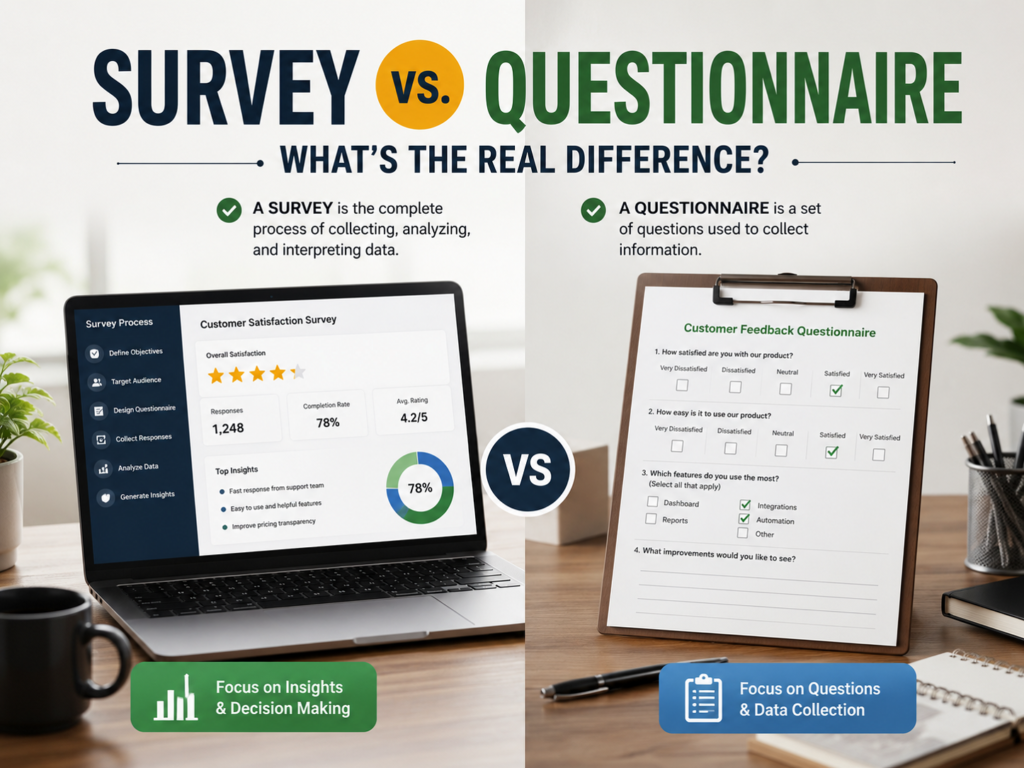
To understand the broader picture of data acquisition, we must first look at its foundational element: the questionnaire. At its core, a questionnaire is a structured instrument consisting of a series of questions designed to gather information from a single respondent. Think of it as the physical or digital document itself—the paper form, the fillable PDF, or the slick Typeform interface waiting for user input.
A questionnaire does not inherently imply statistical analysis, aggregate processing, or overarching trend tracking. Its primary purpose is straightforward: data capture. When a new patient walks into an American medical clinic and fills out an intake form listing their medical history, allergies, and insurance details, they are completing a questionnaire. The clinic does not necessarily intend to aggregate that patient’s data with 10,000 others to write a research paper on regional health trends; they simply need that specific individual’s data for operational execution, risk mitigation, and personal filing.
Key Characteristics of a Questionnaire
- Standalone Instrument: It is the collection tool itself, independent of how the resulting data is ultimately contextualized, parsed, or analyzed.
- Individual Focus: It captures discrete data points from a single respondent for immediate identification, verification, onboarding, or administrative archiving.
- Flexibility in Content: It can contain open-ended inquiries, closed-ended multiple-choice selections, checkboxes, or basic identification fields (name, Social Security number, physical address).
- Lack of Inherent Aggregation: The completion of a questionnaire can be an end in itself. No statistical modeling, dashboard building, or trend visualization is mandatory to make the process complete.
Common Questionnaire Examples
Here are clear examples of standalone questionnaires used across modern commerce and administrative frameworks:
- A job application form collecting employment history, educational background, references, and contact details.
- A customer account creation form on an e-commerce platform.
- A liability waiver filled out before participating in an extreme sport or entering a commercial facility.
- A product registration card used to activate a manufacturer’s warranty.
- An onboarding form for a B2B SaaS product specifying user permissions and enterprise team size.
Deconstructing the Survey: The End-to-End Process
If a questionnaire is the tool, a survey is the entire process of which that tool is a part. A survey is a macro-level research methodology that encompasses the design of the question instrument, the sampling plan used to select respondents, the distribution method, the collection of responses, and critically, the statistical analysis and synthesis of those responses into actionable insights.
When an enterprise executes a survey, the individual responses lose their standalone identity. Instead, they are transformed into data rows within a database, aggregated to uncover trends, correlations, variances, and predictive behaviors. For instance, if an e-commerce giant wants to assess national satisfaction levels with its shipping speeds, it doesn’t look at one user’s response in isolation. It aggregates thousands of responses to determine that 84% of customers in the Pacific Northwest feel shipping is too slow, prompting a logistical overhaul in that specific region.
The Core Lifecycles of a Survey
To fully appreciate the scope of a survey, one must examine its distinct operational phases:
- Hypothesis and Objective Setting: Defining exactly what organizational, financial, or scientific question needs an answer.
- Sampling Strategy: Determining the target demographic and choosing a mathematically viable sample size to ensure statistical significance while controlling for margin of error and confidence levels.
- Instrument Design: Writing the specific questions (the questionnaire) that will accurately extract the metrics required to test the hypothesis.
- Fieldwork and Distribution: Deploying the instrument via email, SMS, telephone, or face-to-face intercepts.
- Data Cleaning and Processing: Filtering out incomplete entries, straight-lining responses, speeders, and anomalous inputs.
- Statistical Analysis: Applying analytical frameworks—ranging from simple descriptive statistics to complex multivariate regressions and ANOVA testing.
- Reporting and Action: Translating charts, p-values, and correlation coefficients into executive presentations that drive business strategy.
Survey vs Questionnaire: Direct Structural Comparison
To help you visualize how these concepts split and intersect, let us map out their core characteristics across key operational metrics.
| Feature / Dimension | Questionnaire | Survey |
| Core Definition | The physical or digital document containing a series of questions. | The complete end-to-end process of collecting, analyzing, and interpreting data. |
| Primary Objective | To capture specific, individual pieces of information. | To uncover broader trends, patterns, and statistical characteristics of a population. |
| Components Involved | Only the questions, layout, and response fields. | Sampling plans, question design, distribution, data aggregation, analysis, and reporting. |
| Data Output Focus | Individualized data points (e.g., user profiles, history details). | Aggregated metrics, percentages, means, medians, and statistical models. |
| Target Scope | Can target a single specific individual with no comparative intent. | Requires a defined sample population representing a larger group. |
| Analytical Requirement | None. Data is often reviewed textually or logged directly into a CRM. | Mandatory. Requires statistical processing to yield meaningful value. |
Why the Distinction Matters in Modern Business and Academia
Confounding these terms might seem harmless, but in practice, miscategorizing your project can derail timelines, balloon budgets, and result in analytical paralysis. Let’s look at why professionals across the US market must maintain clear boundaries between questionnaire vs survey protocols.
1. Resource Allocation and Budgeting
Building a questionnaire is relatively inexpensive. It requires a copywriter or researcher to draft unambiguous questions and an engineer or designer to implement them on a form. The operational cost begins and ends with design and basic software hosting.
A survey, on the other hand, is a capital-intensive project. It demands resources for audience acquisition (often paying panels like Qualtrics or dynamic survey routers), data scientists to clean and weight the responses to match US census demographics, and strategic analysts to build business intelligence dashboards. If you pitch a “questionnaire” to an executive team when you actually intend to deliver a comprehensive market “survey,” you will vastly underbudget for the necessary labor and infrastructure.
2. Tool and Software Selection
If your goal is purely a questionnaire—such as gathering contact information and dietary preferences for an upcoming corporate summit in Chicago—you can use basic, transactional form builders like Google Forms, Jotform, or HubSpot Forms. These tools excel at passing individual entries directly into a spreadsheet or CRM via webhooks.
However, if you are conducting a rigorous market survey to validate a new SaaS feature launch, you need specialized software capable of advanced logic branching, matrix question formatting, randomizing response options to prevent bias, and exporting clean datasets into SPSS, R, or Python. Using a simple web form tool to run a complex survey leads to fragmented data structures and immense frustration during the analysis phase.
3. Data Architecture and Privacy Regulations
In the regulatory landscape governed by frameworks like California’s CCPA/CPRA, Europe’s GDPR, and federal sector-specific mandates (like HIPAA in healthcare), how data is handled hinges heavily on whether it stems from an operational questionnaire or an analytical survey. Questionnaires often capture high-risk Personally Identifiable Information (PII)—names, dates of birth, financial histories—requiring stringent encryption, access controls, and strict compliance logs. Surveys often anonymize or pseudonymize data at the point of ingestion, focusing on aggregate trend lines rather than trackable individual identities, altering the scope of compliance obligations.
Real-World Scenarios: Survey vs Questionnaire Examples
To cement these concepts within a practical, real-world context, let’s explore two specific scenarios that clearly delineate how a questionnaire evolves into a survey, or remains a standalone form.
Scenario A: The Customer Experience Framework (SaaS Enterprise)
Imagine a digital product manager at a Silicon Valley software company tracking how users interact with a new interface design.
- The Questionnaire Aspect: The product manager creates an in-app slide-out modal with three questions: “Rate your ease of navigation from 1-5,” “What feature were you looking for today?” and “Enter your email if you would like a follow-up from our support team.” The physical design and wording of this modal constitute the questionnaire.
- The Survey Execution: When that modal displays to a randomized sample of 5,000 active users over a 30-day period, and the resulting data is funneled into a dashboard showing that users on mobile safari score navigation 1.8 points lower than desktop users, the initiative shifts to a survey. The insights gathered alter the company’s product roadmap.
Scenario B: Employee Engagement and Workplace Culture
A human resources department at a multinational logistics firm based in Texas wants to evaluate corporate health.
- The Questionnaire Instance: During an incident review, an HR manager gives an employee an incident report form to document a workplace safety breach. It captures times, dates, and narratives. This is a questionnaire; it documents an individual event for legal and compliance records.
- The Survey Instance: At the end of Q3, HR distributes an anonymous “Workplace Safety and Trust Index” to all 12,000 warehouse workers nationwide. The data is analyzed across regional operational units to identify management anomalies and implement cultural interventions. This is a full-scale survey.
Designing Better Data Collection Instruments: Best Practices
Whether you are constructing a standalone questionnaire or drafting the question engine for a massive national survey, adherence to core psychological and structural principles is vital. Poorly written questions ruin data integrity, introduce cognitive bias, and drive up abandonment rates.
1. Eradicate Leading and Loaded Questions
A leading question pushes the respondent toward a specific answer, invalidating the objectivity of the instrument. This is a frequent issue in both corporate and political polling.
- Flawed (Leading): “How much did you enjoy our award-winning customer onboarding experience?” (This assumes the user enjoyed it and frames it positively).
- Optimized (Neutral): “How would you rate your experience with our customer onboarding process?” (Options ranging from Very Poor to Excellent).
2. Avoid Double-Barreled Questions
A double-barreled question asks about two distinct issues but allows only a single answer string. This leaves the analyst unable to discern which part of the question the respondent was answering.
- Flawed (Double-Barreled): “Is our software fast and reliable?” (What if a user finds it lightning-fast but prone to daily crashes?).
- Optimized: Split the query into two distinct items: “Rate the speed of our software” and “Rate the reliability of our software.”
3. Keep the Cognitive Load Balanced
Respondents have limited cognitive stamina. If an instrument features endless pages of dense, open-ended text fields, “survey fatigue” sets in. Users will either abandon the session completely or begin selecting arbitrary answers simply to close the screen. Mix closed-ended structured formats (Likert scales, radio buttons, semantic differentials) for efficient data ingestion, and reserve open-ended text boxes for deep qualitative color at strategic milestones.
Conclusion: Choosing the Right Strategy for Your Objectives
When standing at the crossroads of project planning, choosing between a standalone questionnaire or an end-to-end survey comes down to a single question: What do you intend to do with the data?
If your objective is operational, transactional, or administrative—meaning you need to document specific profiles, capture explicit user records, or facilitate an immediate legal or transactional workflow—you are building a questionnaire. Invest your energy into minimizing completion friction, ensuring bulletproof privacy encryption, and engineering seamless integrations with your operational databases.
If your objective is strategic, comparative, or exploratory—meaning you are trying to understand market shifts, evaluate systemic satisfaction, validate scientific hypotheses, or uncover trends within a specific demographic population—you are embarking on a survey. You must scale your mind past the question sheet itself and dedicate rigorous attention to sampling methodologies, statistical variance, bias mitigation, and robust analytical synthesis.
By using the correct terminology and structural frameworks, you align your teams, optimize your capital investments, and build data collection loops that yield true clarity, reliability, and long-term business value.
Frequently Asked Questions (FAQ)
1. What is the difference between a survey and a questionnaire?
A questionnaire is a set of questions used to collect information, while a survey is the complete research process that includes planning, distributing the questionnaire, collecting responses, analyzing data, and drawing conclusions.
In simple terms:
- Questionnaire = Questions
- Survey = Entire research process
2. Is a questionnaire the same as a survey?
No.
Although people often use the terms interchangeably, they are not identical.
A questionnaire is usually one component of a survey.
A survey almost always contains a questionnaire, but a questionnaire can exist without being part of a formal survey.
3. Can you have a questionnaire without a survey?
Yes.
Examples include:
- Registration forms
- Application forms
- Medical intake forms
- Customer onboarding forms
- Event feedback forms
These collect information but may not involve analysis or research.
4. Can you have a survey without a questionnaire?
In most cases, no.
Most surveys use questionnaires to gather information.
However, some surveys may also include interviews, phone calls, or observational methods alongside questionnaires.
5. What is the primary purpose of a questionnaire?
The primary purpose of a questionnaire is to collect standardized information from respondents.
It helps ensure that everyone answers the same questions in the same format.
6. What is the main objective of a survey?
The main objective of a survey is to generate insights that help organizations make informed decisions.
Surveys help answer questions such as:
- Why are customers leaving?
- What products do customers prefer?
- How engaged are employees?
- What improvements should be made?
7. Why do people confuse surveys and questionnaires?
People confuse these terms because:
- Both involve asking questions.
- Most online survey tools use the term “survey” for everything.
- In everyday conversation, the distinction is rarely important.
However, in research and business analytics, the difference matters.
8. What are some survey vs questionnaire examples?
Questionnaire Example:
A form asking customers:
- How satisfied were you?
- Would you recommend us?
Survey Example:
The company:
- Identifies target customers
- Sends the questionnaire
- Analyzes responses
- Creates business recommendations
The survey includes much more than the questions themselves.
9. Which comes first: a survey or a questionnaire?
Typically, survey planning comes first.
Researchers should first define:
- Objectives
- Target audience
- Methodology
Then they create the questionnaire that supports those goals.
10. What types of questionnaires exist?
Common questionnaire types include:
- Structured questionnaires
- Semi-structured questionnaires
- Unstructured questionnaires
Most business surveys use structured questionnaires because they are easier to analyze.
11. What types of surveys exist?
Examples include:
- Customer satisfaction surveys
- Employee engagement surveys
- Market research surveys
- Product feedback surveys
- Healthcare surveys
- Academic research surveys
12. Which is more important: the survey or the questionnaire?
Both are important.
A well-designed questionnaire cannot fix a poorly planned survey.
Likewise, an excellent survey strategy can fail if the questionnaire asks poor questions.
Successful research requires both.
13. Why is understanding the difference important for businesses?
Understanding the difference helps businesses:
- Design better research projects
- Improve data quality
- Make better decisions
- Avoid collecting unnecessary information
- Generate actionable insights
Many companies collect feedback but never conduct proper survey analysis.
14. Is a Google Form a survey or a questionnaire?
A Google Form is usually a questionnaire.
It becomes part of a survey only when it is integrated into a larger research process involving objectives, sampling, analysis, and reporting.
15. What role does survey software play?
Modern survey platforms help organizations manage both questionnaires and surveys by providing:
- Question builders
- Distribution tools
- Analytics dashboards
- Reporting capabilities
- AI-powered insights
16. What is the role of research methodology in surveys?
Research methodology refers to the overall approach used to conduct research.
It includes:
- Defining objectives
- Selecting participants
- Designing questionnaires
- Choosing analysis methods
- Interpreting findings
Survey methodology ensures results are reliable and meaningful.
17. Can questionnaires be used for research?
Yes.
Questionnaires are one of the most common data collection tools in research.
However, questionnaires alone do not constitute research.
Research requires planning, analysis, and interpretation.
18. How does SurveyFlip support surveys and questionnaires?
SurveyFlip helps businesses manage the complete feedback process by offering:
- Questionnaire builders
- Survey templates
- Matrix questions
- Real-time analytics
- AI-powered reporting
- Customer insight dashboards
This allows organizations to move beyond simply collecting responses and focus on making better decisions.
19. Which is better for customer feedback: a survey or a questionnaire?
For simple information gathering, a questionnaire may be enough.
For understanding customer behavior, satisfaction, and decision-making, a complete survey approach is far more effective.
Most businesses benefit from conducting full surveys rather than simply collecting answers.
20. What is the easiest way to remember the difference between a survey and a questionnaire?
A simple way to remember it is:
Questionnaire = The questions
Survey = The entire research process
The questionnaire gathers answers.
The survey turns those answers into insights and actions.