- 11 min read



Design has evolved far beyond aesthetics. In 2026, successful products, websites, services, and digital experiences are expected to be accessible, user-friendly, and welcoming to people from diverse backgrounds and abilities. As organizations focus more on user experience and accessibility, two important concepts frequently appear in design conversations: universal design and inclusive design.
While many people use these terms interchangeably, they are not the same thing.
Understanding the difference between universal design vs inclusive design can help businesses create products that serve more people, improve customer satisfaction, strengthen brand reputation, and meet accessibility expectations.
Whether you are designing a website, survey, mobile application, SaaS platform, workplace environment, or public service, understanding these approaches can help you create better experiences for everyone.
What Is Inclusive Design?
To clearly understand what is inclusive design, we need to look beyond traditional design thinking and focus on human diversity.
Inclusive design is a user-centered approach that aims to ensure as many people as possible can use a product or service, regardless of their abilities, background, or circumstances. It starts with the idea that users are not all the same—and should not be treated as if they are.
Instead of designing for an “average user,” inclusive design acknowledges differences in ability, language, culture, age, gender identity, education level, and access to technology. It actively asks: Who might be excluded from this experience, and why?
A key strength of inclusive design is that it is proactive. Designers do not wait for accessibility issues to appear after launch. Instead, they involve diverse users early in the design process, gather feedback, and adjust the product accordingly.
For example, if a survey platform assumes all users understand technical English terms, it may unintentionally exclude non-native speakers. Inclusive design would address this by simplifying language, offering translations, or providing tooltips and explanations.
In modern product development, inclusive design is not just an accessibility effort—it is a strategy to improve usability, engagement, and customer satisfaction across diverse audiences.
What Is Universal Design?
Universal design takes a broader, more foundational approach.
It is the concept of creating products, environments, and systems that can be used by the widest possible range of people without requiring adaptation or specialized design. The goal is simplicity, accessibility, and usability from the start.
Unlike inclusive design, which often focuses on identifying and removing barriers for specific groups, universal design aims to eliminate barriers altogether during the initial design phase.
The idea originated in architecture but has become highly relevant in digital design. For example, curb cuts in sidewalks were originally designed for wheelchair users, but they benefit parents with strollers, travelers with luggage, and delivery workers. This is universal design in action—one solution benefiting almost everyone.
In digital environments, universal design appears in features like responsive layouts, clear navigation structures, readable typography, keyboard accessibility, and voice-based controls. These features ensure that users do not need separate versions of a product to access it effectively.
The strength of universal design is its scalability. When done well, it reduces the need for special accommodations because the original design already accounts for a wide range of users.
Universal Design vs Inclusive Design: The Core Difference
When comparing universal design vs inclusive design, the main difference lies in approach and intent.
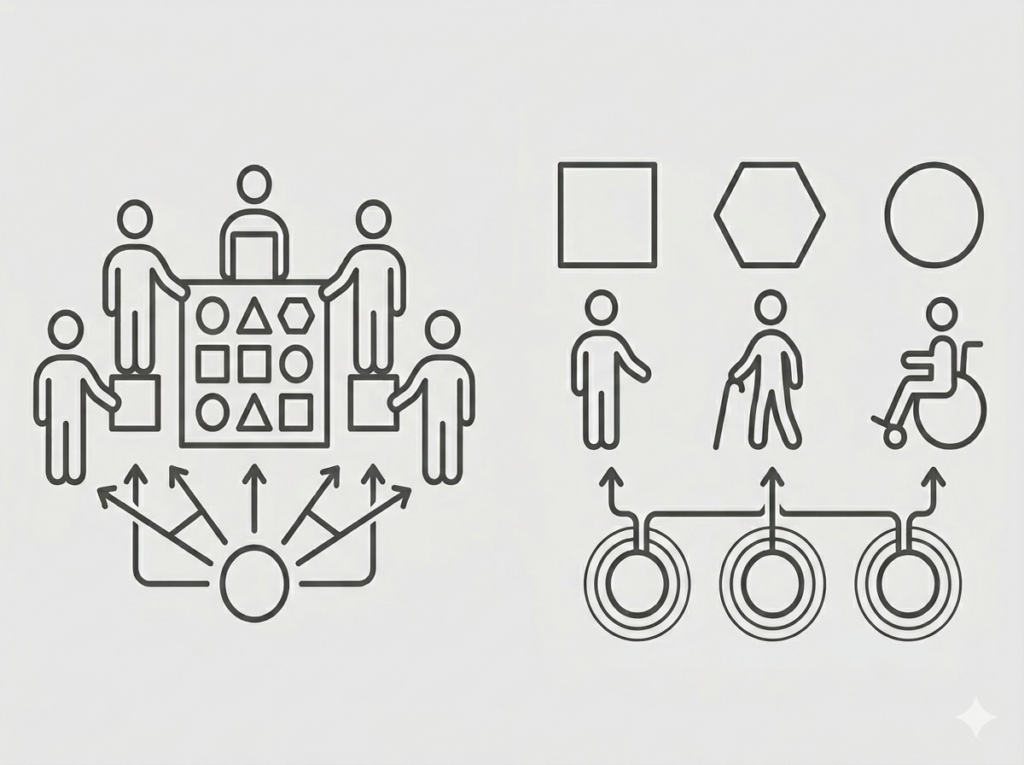
Universal design focuses on building one solution that works for nearly everyone from the beginning. It emphasizes simplicity, broad accessibility, and eliminating barriers at the design stage itself.
Inclusive design, on the other hand, focuses on understanding diversity and continuously improving the product to ensure that different user needs are represented and supported. It accepts that one solution may not fit all users perfectly and therefore encourages flexibility and adaptation.
In practical terms, universal design asks:
“How can we design something that works for the widest range of users right away?”
Inclusive design asks:
“Who might struggle with this design, and how can we improve it for them?”
Both approaches aim to improve usability and accessibility, but they operate at different levels of the design process. Universal design is more structural and foundational, while inclusive design is more iterative and research-driven.
In modern UX and product development, successful organizations often combine both approaches—using universal design principles as a baseline and inclusive design practices to refine and improve experiences over time.
The Seven Universal Design Principles
The concept of universal design principles is widely used in both physical and digital environments. These principles guide designers in creating experiences that are usable by as many people as possible.
1. Equitable Use
Design should be useful and accessible to people with diverse abilities. No user should feel disadvantaged or excluded when using a product.
2. Flexibility in Use
A good design accommodates different preferences and abilities. For example, users should be able to interact using a mouse, keyboard, touchscreen, or voice commands depending on their needs.
3. Simple and Intuitive Use
Interfaces should be easy to understand regardless of experience level, language, or cognitive ability. Complexity should never be a barrier to usability.
4. Perceptible Information
Important information must be communicated clearly, regardless of environmental conditions or user abilities. This may include visual, auditory, and tactile formats.
5. Tolerance for Error
Design should minimize risks and prevent accidental mistakes. If errors occur, they should be easy to correct without major consequences.
6. Low Physical Effort
Users should be able to interact with a product comfortably and efficiently without unnecessary strain or repeated actions.
7. Size and Space for Approach and Use
Products and interfaces should be designed so that users of different body sizes, mobility levels, or devices can interact comfortably.
These principles form the foundation of accessible design across industries and remain highly relevant in modern digital product development.
Inclusive Design Examples in Real-World Applications
To better understand inclusive design examples, it helps to look at how companies apply these principles in practice.
One common example is multilingual support. Websites that offer content in multiple languages ensure that users from different regions can engage without language barriers. This significantly expands global reach and improves usability.
Another example is accessibility features such as screen reader compatibility and keyboard navigation. These ensure that users with visual or motor impairments can still interact fully with digital products.
Captions and transcripts for videos are another powerful example. While they support users with hearing impairments, they also benefit people in noisy environments or those who prefer reading over listening.
Inclusive survey design is also becoming increasingly important. Modern survey tools now support mobile responsiveness, simplified question structures, and flexible input methods. This ensures that respondents from different backgrounds and devices can participate easily.
Even something as simple as adjusting font size or contrast settings can significantly improve accessibility for users with visual challenges or older adults.
These examples show that inclusive design is not limited to accessibility compliance—it improves usability for everyone.
Why Inclusive Design Matters in Modern Business
Inclusive design has become increasingly important in today’s global digital economy.
Businesses now serve diverse audiences across different countries, cultures, and demographics. A product designed for a narrow audience risks excluding large portions of potential users.
Inclusive design helps businesses avoid this problem by ensuring that different user needs are considered throughout the design process.
Beyond accessibility, inclusive design also improves customer satisfaction. When users feel that a product understands their needs, they are more likely to trust the brand and continue using the product.
It also supports innovation. Many successful features in modern technology originated from accessibility needs but later became mainstream improvements used by everyone.
In this way, inclusive design is not just a responsibility—it is a competitive advantage.
Universal Design in the Digital Age
In modern digital environments, universal design plays a critical role in ensuring usability across platforms and devices.
Responsive design is a strong example. Websites that automatically adapt to different screen sizes ensure usability across mobile phones, tablets, and desktops without requiring separate versions.
Voice interfaces such as virtual assistants also reflect universal design principles by allowing hands-free interaction.
Clear navigation systems, readable typography, and consistent layouts further support usability across different user groups.
These features reduce friction and make digital experiences more intuitive for everyone, regardless of experience level or ability.
How Both Approaches Work Together
Rather than choosing between universal design and inclusive design, many organizations find the best results by combining both approaches.
Universal design provides a strong foundation by ensuring broad usability from the beginning. Inclusive design builds on this foundation by continuously improving the experience based on real user feedback and diverse perspectives.
For example, a SaaS platform may use universal design principles to ensure its interface is accessible and easy to navigate. At the same time, it may use inclusive design research to refine language, add localization, and improve workflows for different user groups.
This combination creates products that are both accessible by default and adaptable over time.
Final Thoughts
The discussion around universal design vs inclusive design is not about choosing one over the other. Instead, it is about understanding how both approaches contribute to better user experiences.
Universal design focuses on creating solutions that work broadly from the start, while inclusive design focuses on ensuring diverse user needs are continuously considered and addressed.
When combined effectively, these approaches lead to more accessible, user-friendly, and successful digital products.
For modern businesses, designers, and product teams, adopting both philosophies is no longer optional—it is essential for building experiences that truly serve all users.
Frequently Asked Questions (FAQ)
1. What is the difference between universal design vs inclusive design?
The main difference in universal design vs inclusive design is the approach. Universal design aims to create one solution that works for as many people as possible from the start, while inclusive design focuses on identifying diverse user needs and improving the experience through continuous feedback and adaptation.
2. What is inclusive design in simple terms?
What is inclusive design can be explained simply as designing products and services that consider people with different abilities, backgrounds, and needs. It ensures no group of users is unintentionally excluded from using a product or experience.
3. What are universal design principles?
The universal design principles are guidelines that help designers create accessible and usable products for everyone. They include equitable use, flexibility, simplicity, clear information, error tolerance, low physical effort, and proper size and space for use.
4. Why is inclusive design important?
Inclusive design is important because it helps businesses reach a wider audience, improve user satisfaction, and reduce accessibility barriers. It also ensures that digital products are usable for people with different abilities, languages, and cultural backgrounds.
5. Can you give inclusive design examples?
Yes, some common inclusive design examples include multilingual websites, video captions, screen reader support, mobile-friendly interfaces, adjustable text sizes, and simplified user interfaces for better readability and accessibility.
6. Is universal design better than inclusive design?
Neither is better. Universal design provides a strong foundation for accessibility, while inclusive design ensures continuous improvement based on real user needs. The best results often come from using both together.
7. Where is universal design used in real life?
Universal design is used in websites, mobile apps, public buildings, transportation systems, and digital platforms. Examples include automatic doors, responsive websites, voice assistants, and accessible navigation systems.
8. How do universal and inclusive design improve user experience?
Both approaches improve usability by reducing barriers. Universal design makes products easier for everyone to use from the beginning, while inclusive design ensures the product evolves to meet diverse user needs over time.
9. Who benefits from inclusive and universal design?
Everyone benefits. These design approaches help people with disabilities, older adults, non-native language speakers, mobile users, and even general users who want simpler and more efficient experiences.
10. How do companies apply inclusive design?
Companies apply inclusive design by researching diverse user groups, collecting feedback, testing with real users, improving accessibility features, and continuously updating products based on user needs.
11. What industries use universal design and inclusive design?
These design approaches are used in technology, healthcare, education, government services, e-commerce, SaaS platforms, and product design industries where accessibility and usability are important.
12. Why is accessibility important in modern design?
Accessibility ensures that digital products can be used by everyone, including people with disabilities. It improves usability, expands audience reach, and is often required by legal and compliance standards.
13. How do inclusive design and universal design work together?
Universal design provides a strong baseline of accessibility, while inclusive design refines the experience based on real user diversity. Together, they create more effective, user-friendly, and widely accessible products.