- 12 min read


Customer expectations are evolving faster than ever. In 2026, businesses can no longer rely on assumptions when making decisions about products, services, customer support, or marketing strategies. The most successful companies are those that actively listen to their customers and use feedback to improve every aspect of the customer experience.
This is why learning how to create a survey for customer feedback has become an essential skill for businesses of all sizes. Whether you run a startup, SaaS platform, e-commerce store, agency, or enterprise organization, customer feedback surveys provide valuable insights that help you understand what customers love, what frustrates them, and what improvements they want to see.
However, creating an effective survey is more than simply asking a few questions. Poorly designed surveys often produce inaccurate data, low response rates, and misleading conclusions. A well-designed survey, on the other hand, can uncover actionable insights that drive customer satisfaction, loyalty, retention, and revenue growth.
In this guide, you’ll learn exactly how to create a survey for customer feedback, what questions to ask, common mistakes to avoid, and how modern AI-powered survey tools are transforming feedback collection in 2026.
Why Customer Feedback Matters More Than Ever
Every customer interaction generates valuable information. Customers constantly form opinions about products, pricing, support quality, website usability, onboarding experiences, and overall brand perception.
The challenge is that businesses often don’t hear these opinions unless they actively ask for them.
Customer feedback helps businesses understand:
- Customer satisfaction levels
- Product strengths and weaknesses
- Service quality
- Customer expectations
- Pain points and frustrations
- Improvement opportunities
Without feedback, companies often make decisions based on assumptions rather than real customer experiences.
Businesses that consistently collect and analyze customer feedback can make smarter decisions, improve customer experiences, and stay ahead of competitors.
What Is a Customer Feedback Survey?
A survey for customer feedback is a structured questionnaire designed to collect opinions, experiences, suggestions, and satisfaction levels from customers.
These surveys help businesses gather direct input from their audience and transform customer opinions into measurable data.
Customer feedback surveys can focus on:
- Product feedback
- Customer service feedback
- Website experience
- User experience
- Purchase experience
- Brand perception
- Customer loyalty
- Feature requests
The goal is to understand the customer perspective and use those insights to improve business performance.
Define the Purpose of Your Survey First
One of the biggest mistakes businesses make is creating surveys without a clear objective.
Before writing a single question, determine exactly what you want to learn.
For example, are you trying to:
- Improve customer support?
- Understand product satisfaction?
- Measure customer loyalty?
- Reduce customer churn?
- Gather feature requests?
- Improve onboarding?
A survey with a clear purpose produces much better data than a survey that tries to measure everything at once.
When businesses focus on one primary goal, they can ask more relevant questions and collect more useful insights.
Identify Your Target Audience
Not every customer should receive the same survey.
Different customer groups often have different experiences and expectations.
For example:
- New customers may provide onboarding feedback.
- Long-term customers may provide loyalty insights.
- Churned customers can explain why they left.
- Support users can evaluate service quality.
- Premium customers may offer strategic improvement suggestions.
Segmenting your audience helps ensure survey responses are relevant and actionable.
Modern survey platforms make it easy to send customized surveys to different customer segments automatically.
Keep Surveys Short and Focused
One of the most important rules when learning how to create a survey for customer feedback is simplicity.
Customers are busy. The longer a survey becomes, the lower the completion rate tends to be. Many businesses make the mistake of asking dozens of questions when only a handful are truly necessary. Instead, focus on collecting the most valuable information.
A survey that takes two to five minutes to complete often performs significantly better than one that requires fifteen minutes or more.
Short surveys:
- Increase completion rates
- Improve data quality
- Reduce respondent fatigue
- Generate more accurate answers
Customers are far more likely to participate when surveys respect their time.
Ask Clear and Simple Questions
Survey questions should be easy to understand and answer.
Avoid:
- Complex wording
- Industry jargon
- Technical language
- Multiple questions in one sentence
For example, instead of asking:
👉 “How satisfied are you with our pricing, support team, and product features?”
Ask separate questions about pricing, support, and features.
Clear questions produce cleaner data and reduce confusion.
Customers should immediately understand what each question is asking.
Use a Mix of Question Types
Effective customer feedback surveys usually combine several question formats.
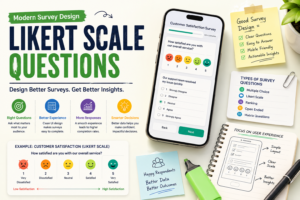
🎯 Different question types provide different types of insights.
🎯 Rating scale questions help measure satisfaction numerically.
🎯 Multiple-choice questions help identify preferences and trends.
🎯 Open-ended questions allow customers to explain opinions in their own words.
For example:
👉 “How satisfied are you with our product?”
(1–10 rating scale)
👉 “What feature do you use most often?”
(Multiple choice)
👉 “What improvements would you like to see?”
(Open-ended response)
Using multiple question formats helps businesses collect both quantitative and qualitative feedback.
Include Customer Satisfaction Questions
Customer satisfaction should be a core component of most feedback surveys.
Satisfaction questions help businesses understand how customers feel about their experiences.
Examples include:
- How satisfied are you with our product?
- How satisfied are you with our customer support?
- How likely are you to continue using our service?
- How would you rate your overall experience?
These questions provide valuable benchmarks that can be tracked over time.
Businesses can compare satisfaction scores month after month to identify trends and measure improvements.
Ask Open-Ended Questions
While rating scales provide measurable data, open-ended questions often generate the most valuable insights.
These questions allow customers to explain their thoughts in detail.
Examples include:
- What do you like most about our product?
- What challenges have you experienced?
- What feature would you like us to add?
- How can we improve your experience?
Open-ended responses often reveal opportunities and problems that businesses never considered.
In many cases, a single detailed response can lead to significant product improvements.
Avoid Leading Questions
Leading questions push customers toward specific answers.
This can distort results and reduce survey accuracy.
For example:
👉 “How much do you love our new product features?”
This assumes customers already love the features.
A better question would be:
👉 “How would you rate your experience with our new product features?”
Neutral wording helps ensure customers provide honest feedback.
The goal of a survey for customer feedback is to discover the truth—not to confirm assumptions.
Choose the Right Survey Timing
Survey timing has a major impact on response rates and feedback quality.
The best time to request feedback depends on the experience being measured.
For example:
👉 After a support interaction, send a survey immediately.
👉 After onboarding, wait until customers have had enough time to use the product.
👉 After a purchase, request feedback once the customer has received and used the product.
Relevant timing helps ensure responses are accurate and meaningful.
Optimize Surveys for Mobile Devices
In 2026, most customers interact with surveys using smartphones.
If a survey is difficult to complete on mobile devices, participation rates will suffer.
Mobile-friendly surveys should:
- Load quickly
- Use simple layouts
- Include large touch-friendly buttons
- Avoid excessive scrolling
- Display properly on all screen sizes
A responsive design improves both user experience and completion rates.
Use AI to Improve Survey Performance
Artificial intelligence is transforming customer feedback collection.
Modern AI-powered survey platforms can:
- Generate survey questions automatically
- Analyze customer sentiment
- Detect response patterns
- Identify emerging trends
- Predict customer churn
- Personalize survey experiences
AI helps businesses collect better data while reducing manual work.
Instead of spending hours analyzing responses manually, businesses can now receive instant insights and recommendations.
This is one of the biggest reasons AI-powered survey tools continue growing rapidly in popularity.
Analyze the Results Carefully
Collecting survey responses is only the beginning.
The real value comes from analyzing the data and taking action.
Look for:
- Recurring complaints
- Frequently requested features
- Customer satisfaction trends
- Common pain points
- Positive feedback themes
Businesses should prioritize issues that appear repeatedly across multiple responses.
Patterns often reveal opportunities for meaningful improvements.
The goal is not simply to gather feedback but to use it effectively.
Close the Feedback Loop
One of the most overlooked aspects of customer feedback is communication.
Customers appreciate knowing that their opinions matter.
Whenever possible, businesses should:
- Thank customers for participating
- Share improvements based on feedback
- Communicate product updates
- Demonstrate that feedback influenced decisions
Closing the feedback loop builds trust and encourages future participation.
Customers are more likely to provide feedback again when they see their input making a difference.
Common Mistakes to Avoid
Many businesses unintentionally reduce survey effectiveness through avoidable mistakes.
Common problems include:
- Surveys that are too long
- Unclear questions
- Asking too many open-ended questions
- Sending surveys too frequently
- Ignoring collected feedback
- Failing to act on survey results
Avoiding these mistakes can significantly improve response rates and data quality.
The best surveys are simple, focused, and designed around customer convenience.
The Future of Customer Feedback Surveys
Customer feedback is becoming more intelligent, personalized, and automated.
Emerging trends include:
- AI-generated surveys
- Conversational feedback experiences
- Real-time sentiment analysis
- Predictive customer insights
- Personalized survey journeys
- Voice-based feedback collection
Businesses that embrace these technologies will gain deeper customer understanding and faster access to actionable insights.
The future of feedback collection is not just about gathering data—it is about creating meaningful conversations with customers.
Final Thoughts
Learning how to create a survey for customer feedback is one of the most valuable skills businesses can develop in 2026.
A well-designed survey for customer feedback helps organizations understand customer needs, improve experiences, increase loyalty, and make smarter business decisions.
The most successful surveys are focused, easy to complete, mobile-friendly, and designed around clear objectives. They ask the right questions, collect actionable insights, and help businesses transform customer opinions into meaningful improvements.
In a marketplace where customer expectations continue to rise, listening to customers is no longer optional. Businesses that actively collect and act on customer feedback will be better positioned to grow, innovate, and maintain long-term customer relationships.
Frequently Asked Questions (FAQ)
1. What is a customer feedback survey?
A customer feedback survey is a structured questionnaire designed to collect opinions, experiences, suggestions, and satisfaction ratings from customers. Businesses use these surveys to understand customer needs and improve products, services, and overall customer experiences.
2. Why is customer feedback important for businesses?
Customer feedback helps businesses identify strengths, uncover weaknesses, improve customer satisfaction, reduce churn, and make data-driven decisions. It provides direct insights into what customers think and expect from a brand.
3. How do I create a survey for customer feedback?
To create a successful customer feedback survey:
- Define a clear objective.
- Identify your target audience.
- Keep the survey short and focused.
- Ask clear and unbiased questions.
- Use a mix of rating, multiple-choice, and open-ended questions.
- Optimize the survey for mobile devices.
- Analyze results and take action on feedback.
4. How long should a customer feedback survey be?
Most customer feedback surveys should take between 2 and 5 minutes to complete. Shorter surveys generally achieve higher response rates and better-quality responses.
5. What questions should I include in a customer feedback survey?
Common customer feedback questions include:
- How satisfied are you with our product or service?
- How likely are you to recommend us to others?
- What do you like most about our product?
- What improvements would you like to see?
- How would you rate your overall experience?
6. What is the best time to send a customer feedback survey?
The best time depends on the customer interaction. For example:
- After a purchase
- After customer support interactions
- After onboarding completion
- Following a product update
- Before subscription renewal
Timely surveys typically receive more accurate and useful responses.
7. How can I increase customer feedback survey response rates?
To improve response rates:
- Keep surveys short.
- Use simple language.
- Make surveys mobile-friendly.
- Personalize survey invitations.
- Explain the purpose of the survey.
- Offer incentives when appropriate.
- Send surveys at relevant moments in the customer journey.
8. Should I use open-ended questions in my survey?
Yes. Open-ended questions allow customers to provide detailed feedback and explain their experiences in their own words. These responses often reveal valuable insights that rating-scale questions cannot capture.
9. What are common mistakes to avoid when creating a customer feedback survey?
Common mistakes include:
- Asking too many questions
- Using confusing language
- Asking leading or biased questions
- Ignoring survey results
- Sending surveys too frequently
- Failing to communicate improvements made from feedback
10. How does AI improve customer feedback surveys?
Modern AI-powered survey tools can:
- Generate survey questions automatically
- Analyze customer sentiment
- Detect trends and patterns
- Identify churn risks
- Categorize open-ended responses
- Provide real-time insights and recommendations
AI helps businesses collect and analyze feedback more efficiently.
11. What is the difference between customer feedback and customer satisfaction?
Customer feedback includes all customer opinions, suggestions, complaints, and experiences. Customer satisfaction specifically measures how happy customers are with a product, service, or interaction.
12. Which businesses should use customer feedback surveys?
Almost every business can benefit from customer feedback surveys, including:
- SaaS companies
- E-commerce stores
- Restaurants
- Healthcare providers
- Educational institutions
- Marketing agencies
- Financial services companies
- Small businesses and startups
13. How often should businesses collect customer feedback?
Most businesses should collect feedback continuously throughout the customer journey. Regular feedback helps identify issues early and track customer satisfaction trends over time without overwhelming customers.
14. What are the benefits of using an online survey tool for customer feedback?
Online survey tools help businesses:
- Create surveys quickly
- Automate distribution
- Collect responses in real time
- Analyze data efficiently
- Improve customer engagement
- Make informed business decisions based on customer insights
15. What is the future of customer feedback surveys?
The future of customer feedback includes AI-powered analytics, conversational surveys, predictive customer insights, real-time sentiment analysis, personalized survey experiences, and automated action recommendations. These innovations will help businesses better understand and respond to customer needs in 2026 and beyond.