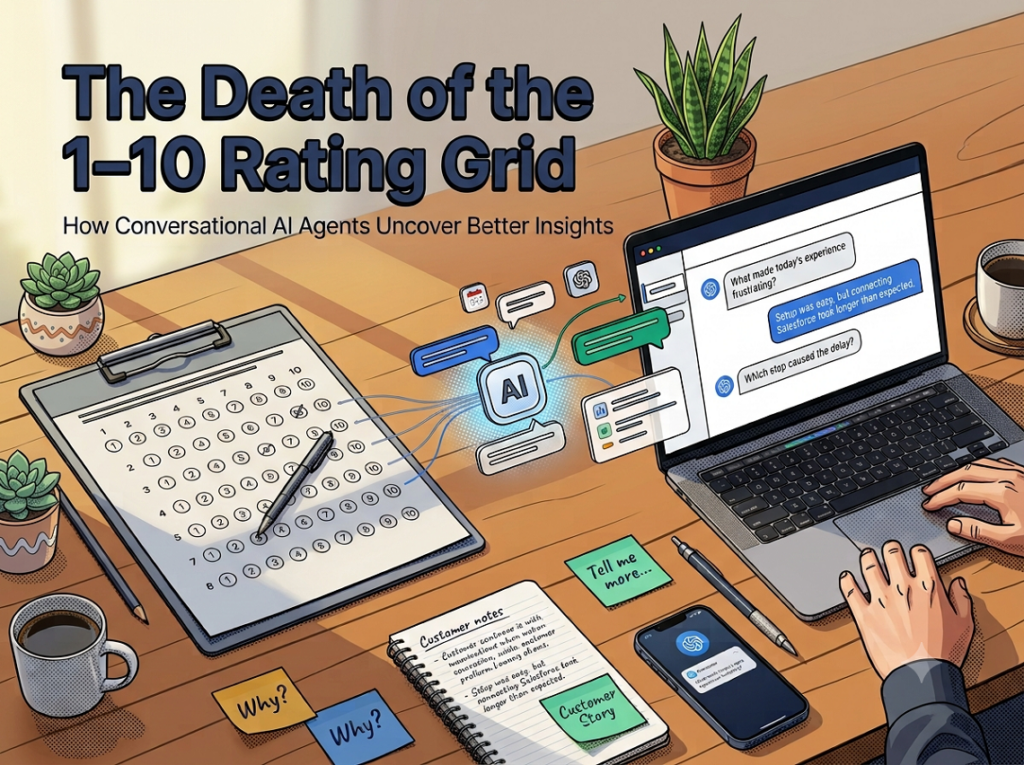
For decades, market researchers and Customer Success teams relied on one familiar workhorse: the 1–10 rating grid.
You have filled them out dozens of times yourself. You complete a purchase, end a customer support chat, or log into your software workspace, and a form pops up asking: “On a scale of 1 to 10, how satisfied were you with your experience today?”
For a long time, business executives loved these grids. They produced clean numbers and filled out neat dashboards. They allowed executives to present quarterly scorecards with bullet points showing a Customer Satisfaction (CSAT) score of 8.2 or a Net Promoter Score (NPS) of +42.
There is only one problem: 1–10 rating grids are dying.
In today’s digital landscape, static rating scales yield plummeting completion rates, biased results, and zero context. They tell you what score a user clicked, but they never tell you why they clicked it.
Enter the next era of customer research: conversational AI surveys.
By replacing rigid matrix forms with intelligent, adaptive AI agents, forward-thinking brands are capturing deep qualitative insights at scale. In this article, we examine why static rating scales fail, how AI customer feedback tools work, and how one company unlocked unprecedented customer insights while saving hundreds of product hours.
Why the Traditional 1–10 Rating Grid Is Broken
To understand why conversational AI is taking over, we must look at why traditional survey grids no longer work for modern consumers and B2B buyers.
1. Survey Fatigue Is at an All-Time High
Consumers and business professionals are inundated with feedback requests. Every ride-share, delivery app, email, and software login asks for a rating. As a result, users experience severe survey fatigue. Average response rates for traditional email and web surveys have collapsed to under 3%.
2. The Arbitrary Nature of Numerical Scores
What does a score of “7 out of 10” actually mean?
- To a harsh critic, a 7 might mean “Everything went great, but nobody is perfect.”
- To an easygoing user, a 7 might mean “This feature was confusing, but I managed to finish my task.”
- To an enterprise buyer, a 7 might mean “I am actively shopping for a replacement tool.”
Numerical scales flatten human emotion into arbitrary numbers. Without open-ended context, teams spend weeks debating what a fraction of a point shift in their monthly average actually signifies.
3. Click-Through Bias and Rating Polarized Data
When presented with a long grid of radio buttons, users typically behave in one of three ways:
- They close the window immediately.
- They click through randomly just to clear the pop-up screen.
- They only respond if they are extremely angry or deeply delighted.
This creates a severe polarization bias. You hear from your most vocal 5% of users, while the quiet 95%—the majority who experience minor frictions that cause silent churn—never tell you what is wrong.
4. The Qualitative Gap
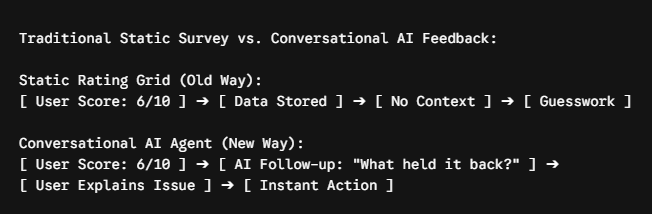
When a user selects a “4 out of 10” on a static web form, what happens next? Usually, nothing. The form submits, a generic “Thank you for your feedback!” screen appears, and the response gets buried in a spreadsheet.
If you want to know how AI agents improve survey response rates, the answer lies in eliminating this dead end. Static forms are one-way data extraction. Conversational interactions feel like meaningful dialogue.
What Are Conversational AI Surveys?
A conversational survey replaces static form fields with a dynamic, voice- or text-based interactive agent. Instead of making users read a list of predefined questions, an AI agent engages the user in a natural, adaptive conversation.
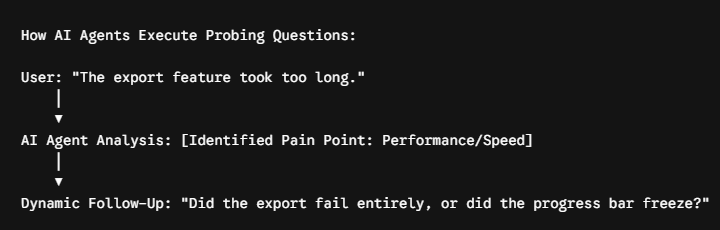
Key capabilities of modern AI customer feedback tools include:
- Real-Time Context Awareness: The AI knows which page the user is viewing, what feature they just used, and their account tier.
- Adaptive Follow-Up Probing: If a user leaves a vague comment like “The dashboard is confusing,” the AI agent immediately follows up: “Which specific chart or metric was hardest to find?”
- Natural Language Processing (NLP): Users can type in plain English, speak via voice notes, or answer in brief phrases. The AI understands intent, sentiment, and tone.
- Dynamic Branching: The conversation adapts based on sentiment. Highly satisfied users receive referral or review prompts, while frustrated users receive immediate empathy and support routing.
By leveraging AI agents for qualitative customer research, organizations can conduct the equivalent of thousands of 1-on-1 user interviews simultaneously.
Comparison: Static Forms vs. Conversational AI Surveys
| Feature | Static 1–10 Rating Grids | Conversational AI Surveys |
| User Experience | Rigid, repetitive form fields | Natural, human-like dialogue |
| Response Rates | Low (Typically 2% – 5%) | High (Often 25% – 40%) |
| Context Captured | Numerical scores only | Deep qualitative explanations |
| Follow-Up Ability | None (Static question set) | Real-time dynamic probing |
| Completion Speed | Feels like labor for the user | Short, engaging micro-interactions |
| Actionability | Requires manual data analysis | Automated sentiment and topic tagging |
Case Study: How Company Y Replaced Rating Grids with AI Agents
To evaluate the real-world impact of moving away from static rating scales, let us look at a case study featuring a high-growth B2B SaaS platform. For privacy and non-disclosure compliance, we will refer to this organization as Company Y.
The Company Profile
- Industry: B2B Cloud Collaboration & Document Management
- Target Market: Mid-market and Enterprise Operations Teams in North America
- User Base: 120,000+ active monthly users
- Previous Feedback Method: Monthly CSAT pop-ups featuring a standard 1–10 matrix grid
The Challenge: Low Engagement and Zero Context
Company Y faced a classic feedback bottleneck. Their product team launched three major feature updates over a six-month period. To track user satisfaction, they triggered a standard 1–10 CSAT survey after users interacted with the new tools.
The results were frustrating:
- Completion rate was just 2.1%.
- Out of 10,000 impression triggers, only 210 users submitted a rating.
- Over 80% of respondents selected a numerical score without leaving any text in the optional comment box.
- Product managers were left with an average score of 6.8/10, but had no idea what changes to make to improve the experience.
Company Y needed a system that could turn customer survey data into churn prevention by unlocking the specific reasons behind low scores.
The Solution: Deploying Conversational AI Agents with SurveyFlip
Company Y retired their 1–10 rating grid entirely. In its place, they implemented SurveyFlip to power real-time, conversational micro-surveys.
Instead of displaying a multi-question matrix, Company Y deployed a sleek, unobtrusive conversational widget in the bottom corner of their application screen.
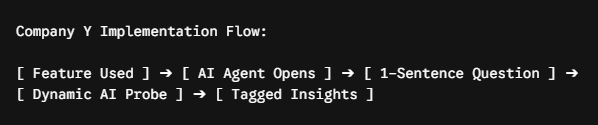
The 3-Step Conversational Workflow
- The Initial Gentle Prompt: When a user completed an action (such as sharing a file container), the AI agent asked a single plain-language question: “How did that file export feel to you just now?”
- The Adaptive Follow-Up:
- If the user answered “It was fine,” the AI agent did not stop there. It gently probed: “Glad to hear that! Was there anything about the file permissions step that felt slow?”
- If the user answered “Frustrating,” the AI agent responded with empathy: “I’m sorry to hear that. What specifically got in your way?”
- Automated Categorization: The conversational AI surveys automatically categorized responses into actionable buckets (e.g., UI Friction, Slow Processing Speed, Missing Permission Toggle) and routed them directly to the product engineering team.
The Results: 10x Qualitative Data and Higher Engagement
Within 90 days of replacing static grids with SurveyFlip’s conversational AI agents, Company Y achieved transformative operational improvements.
Key Metrics Comparison
- Survey Completion Rate: Jumped from 2.1% to 28.6%.
- Qualitative Insight Yield: Increased by 1,100% (11x more open-ended text responses gathered).
- Engineering Cycle Efficiency: Product managers reduced feature research time by 45% because user pain points were clearly articulated.
- Customer Churn Rate: Decreased gross churn by 3.4% in the first two quarters due to rapid resolution of newly identified UI friction points.
“We spent years guessing what a ‘6 out of 10’ meant,” noted Company Y’s VP of Product. “When we switched to conversational AI surveys through SurveyFlip, users started explaining their problems in exact detail. It was like having a user researcher standing right next to every single customer.”
4 Reasons Why AI Conversational Surveys Drive Better Insights
Why do AI customer feedback tools drastically outperform legacy forms? Here are four core psychological and operational drivers:
1. Conversational Probing Uncovers the “Root Cause”
Human beings rarely express their core issue in their first sentence. When asked for feedback, people often give superficial answers like “It was okay” or “Didn’t work well.”
Static forms accept these superficial answers and close the survey. An AI agent, however, reads the intent and asks a logical follow-up question. This technique—often called the “5 Whys” methodology in product management—extracts the underlying cause of customer frustration without requiring human researchers.
2. Reduced Cognitive Load for the Respondent
Evaluating a 1–10 grid requires cognitive effort:
- Is this experience an 8 or a 7?
- What is the difference between a 4 and a 5 on this matrix?
Conversational AI removes this friction. Users simply speak or type their thoughts naturally, exactly as if they were sending a message to a colleague on Slack or iMessage.
3. Immediate Empathy Builds Brand Loyalty
When a customer inputs a “1 out of 10” on a traditional form, the system usually responds with a robotic, pre-programmed “Thank you.” This cold response can alienate an already annoyed user.
Conversational AI agents acknowledge negative sentiment in real time:
“That sounds frustrating. Thank you for pointing out that error. I am flagging this issue directly for our technical team right now.”
This instant validation turns negative experiences into moments of customer delight and retention.
4. Continuous Synthesis of Unstructured Data
In the past, gathering thousands of open-ended text comments created a nightmare for data analysts. Reading through thousands of qualitative survey responses took weeks.
Modern AI customer feedback tools solve this by analyzing qualitative research instantly. The AI groups thousands of conversational transcripts into key themes, sentiment categories, and prioritized feature requests in real time.
How SurveyFlip Helps You Retire Rating Grids
If your team wants to transition from outdated rating scales to dynamic AI agents, SurveyFlip provides the end-to-end infrastructure to execute this strategy seamlessly.
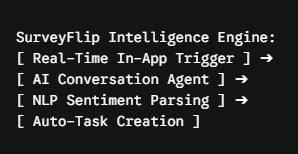
Key SurveyFlip Features for AI-Driven Research
- Autonomous Conversational Agents: Deploy intelligent AI survey agents that adapt their tone, follow-up questions, and language based on user behavior and sentiment.
- Context-Aware Triggering: Launch micro-conversations based on specific in-app events, user attributes, or retention risk scores.
- Automated Qualitative Summaries: SurveyFlip’s AI engine distills thousands of open-ended chat responses into executive summaries, highlight reels, and prioritized action items.
- Seamless Workflow Integrations: Push actionable feedback directly into Slack, Microsoft Teams, Jira, HubSpot, or Salesforce so your product and support teams can act immediately.
- No-Code Implementation: Set up and customize conversational AI agents in minutes using SurveyFlip’s visual editor—no engineering bandwidth required.
Step-by-Step Guide: Moving to Conversational Surveys
Transitioning your organization from static 1–10 grids to conversational AI does not have to be overwhelming. Follow this simple three-step rollout plan:
1.Audit Your Existing Survey Touchpoints:Step 1.
Review all current CSAT, NPS, and product feedback forms. Identify high-traffic areas where completion rates are below 5% or where qualitative comments are consistently missing.
2.Replace Matrix Forms with Single-Prompt AI Triggers:Step 2.
Swap multi-question rating grids for a simple, single conversational prompt powered by SurveyFlip. Start with high-impact moments, such as immediately after a user completes account setup or exports a report.
3.Connect Insights Directly to Product & CS Workflows:Step 3.
Configure automated alerts so that critical qualitative feedback reaches your team immediately. Route technical bugs to Jira and high-value account issues to your Customer Success workspace in Slack.
The Future of Customer Feedback Is Conversational
The era of asking busy customers to fill out tedious 1–10 rating grids is coming to an end. Static scales yield empty metrics, low response rates, and blind spots that hide impending customer churn.
By adopting conversational AI surveys, forward-thinking companies are turning passive feedback collection into an active engine for discovery and retention. They capture real stories, uncover hidden product friction, and show their customers that their voices are genuinely heard.
It is time to stop asking users for numbers and start having real conversations.
Frequently Asked Questions
1. What are conversational AI surveys?
Conversational AI surveys replace rigid 1–10 rating scales and static form fields with dynamic, interactive AI agents. Instead of forcing users to fill out fixed matrix forms, an AI agent engages them in a natural, adaptive dialogue to capture context and deeper qualitative insights.
2. Why are traditional 1–10 rating grids failing?
Traditional rating grids suffer from extremely low response rates (often under 3%), high survey fatigue, and severe polarization bias (only extremely angry or delighted users respond). Most importantly, numerical scores tell you what rating a user selected, but never explain why they chose it.
3. How do AI agents improve survey response rates?
AI agents reduce cognitive friction by asking simple, plain-language questions inside the user’s active workflow instead of sending long email forms. By turning data collection into a quick, natural conversation rather than a chore, response rates often jump from under 3% to over 25%.
4. How does conversational AI handle vague user feedback?
When a user provides a broad or ambiguous answer like “The feature felt slow” or “It was confusing,” the AI agent automatically asks a logical, context-aware follow-up question (e.g., “Which specific step or screen took the longest to load?”) to uncover the root cause.
5. Can AI customer feedback tools analyze large volumes of text data automatically?
Yes. Modern conversational feedback platforms use Natural Language Processing (NLP) to read, categorize, and tag thousands of qualitative chat transcripts instantly. They group open-ended responses into key themes, sentiment categories, and prioritized feature requests without requiring manual coding.
6. Will conversational AI surveys annoy users who just want to complete a quick action?
No. High-performing AI feedback platforms use micro-interactions—often just 1 short initial question with dynamic branching. If a user chooses not to engage further, the interaction ends immediately without interrupting their primary workflow.
7. How do conversational surveys help prevent customer churn?
By asking adaptive follow-up questions when a user expresses dissatisfaction, AI agents uncover specific product friction points before the account cancels. This real-time qualitative context allows Customer Success and Product teams to resolve issues proactively.
8. How does conversational AI differ from basic conditional survey logic?
Traditional conditional logic uses rigid “if/then” rules that must be manually configured beforehand. Conversational AI dynamically interprets the user’s exact sentiment and text intent in real time, crafting tailored follow-up questions on the fly based on context.
9. What are the best user journey touchpoints for launching conversational AI surveys?
Ideal placement includes high-impact or post-value moments, such as:
- Right after completing onboarding setup steps.
- Immediately following a core feature action (e.g., exporting a report, sharing a workspace).
- After interacting with customer support or self-service documentation.
10. How does SurveyFlip implement conversational AI surveys?
SurveyFlip offers an end-to-end, no-code platform with intelligent AI survey agents that trigger contextually in-app. Responses are automatically synthesized and routed directly to team workspaces like Slack, Microsoft Teams, Jira, HubSpot, or Salesforce for immediate action.